
Back to Challenging oppressive policing
T he Tottenham Three and the Broadwater Farm Defence Campaign
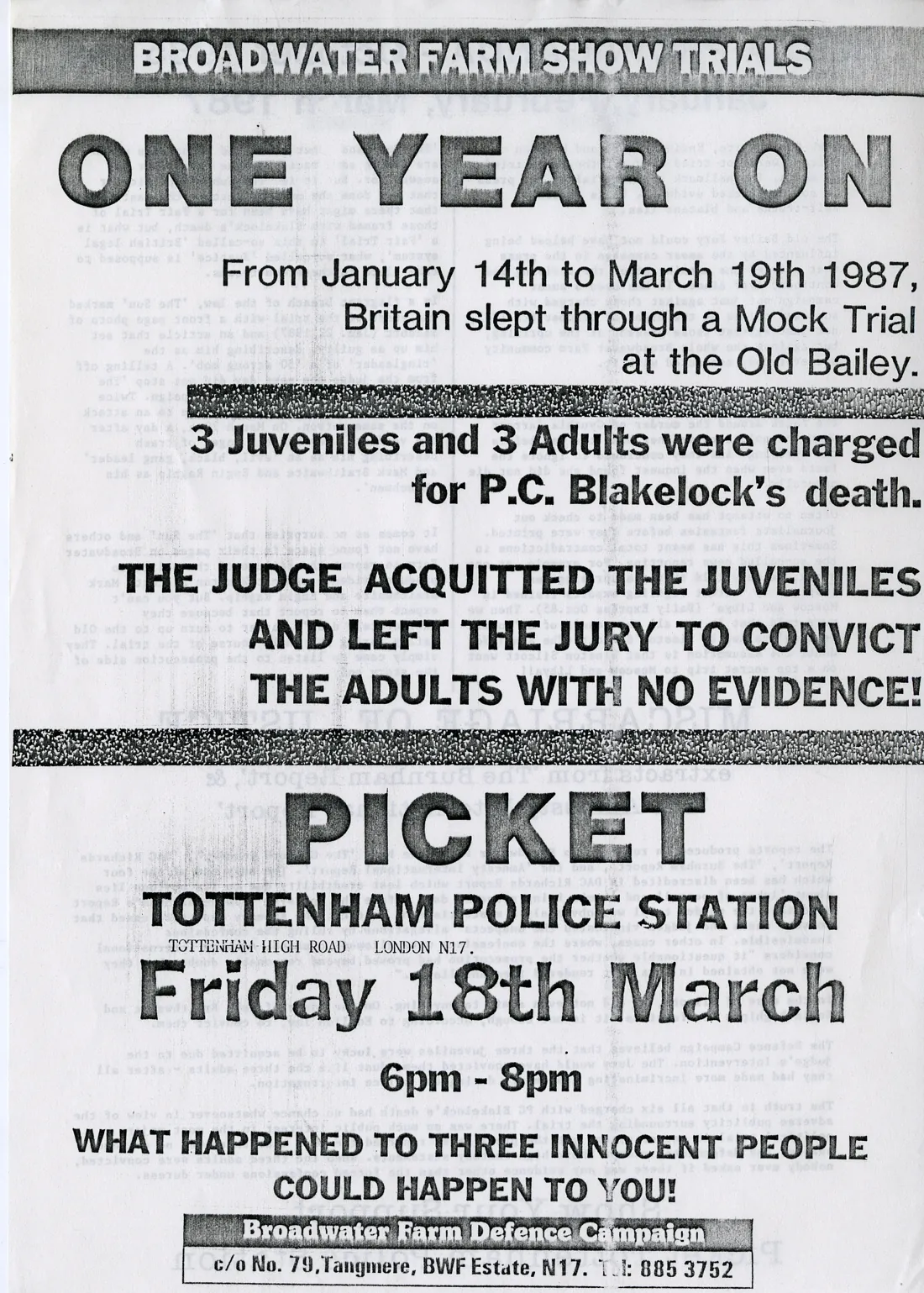
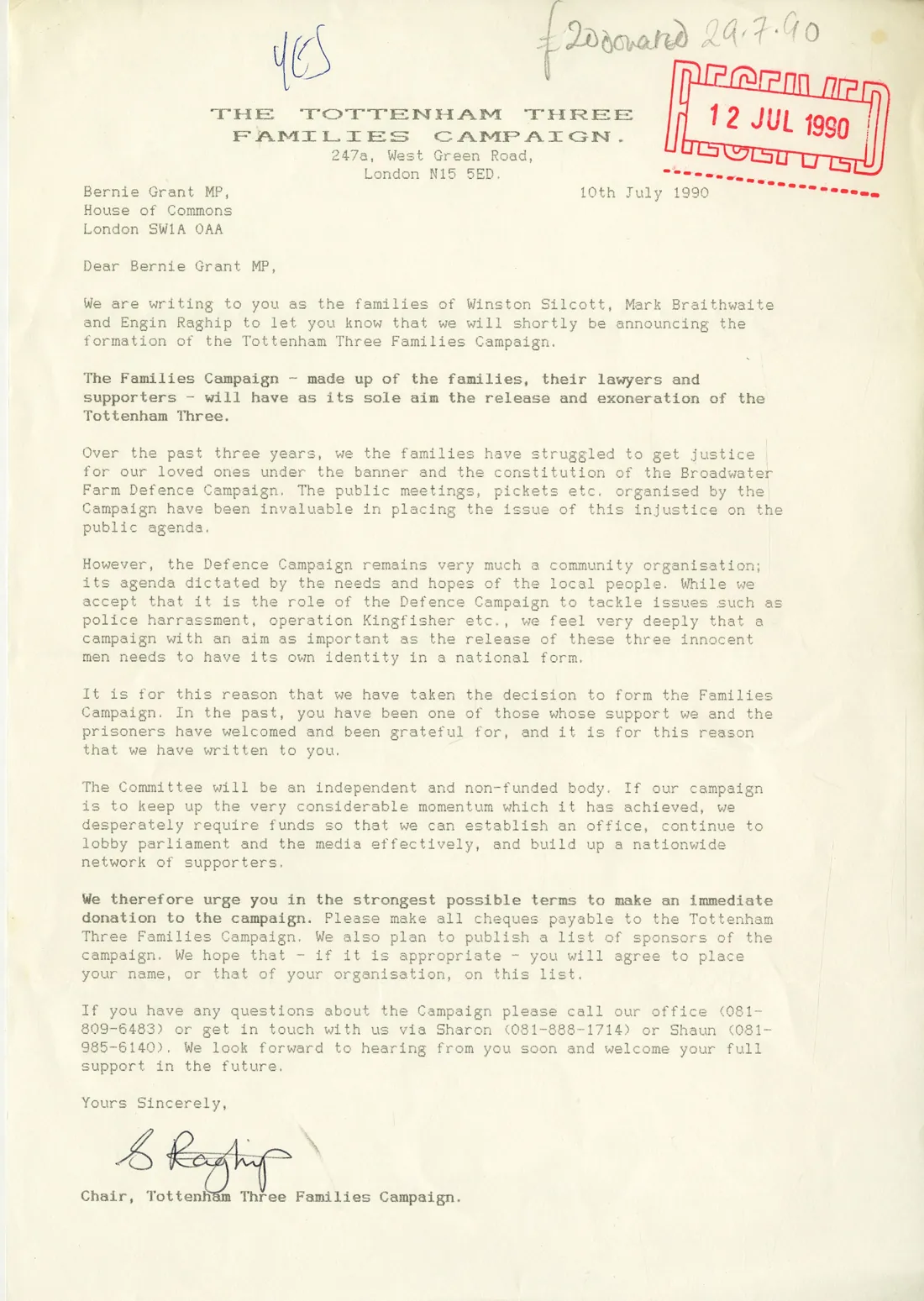
As a result of the swathe of arrests of local young people in the aftermath of the Uprising, three adults and three minors were charged with the murder of PC Blakelock. The three minors were eventually acquitted, however the adults : Winston Silcott, Engin Raghip and Mark Braithwaite, were charged and found guilty in 1987, based on uncorroborated witness statements and coerced confessions. They became known as the ‘Tottenham Three’. Throughout the trial and after the Tottenham Three’s convictions, the local community mobilised in their defence. Grant contributed to the Broadwater Farm Defence Campaign. In March 1987, shortly after the conviction of the Three, the Campaign organised a picket, labelling the trial a “mock trial” that Britain “slept through”. The Tottenham Three Families Campaign was organised by the families of the wrongfully convicted men – namely Sharon Raghip, wife of Engin Raghip – in July 1990 with the aim of “the release and exoneration of the Tottenham Three”, and the two groups worked in tandem with each other to fight for justice. Alike to reportage of the Uprising itself, media outlets were quick to vilify the three men, and in particular Winston Silcott, who was portrayed as the ringleader of Blakelock’s killing despite no credible evidence that he was present on the Farm at the time. Grant regularly challenged the media’s irresponsible portrayal of Silcott. In December 1989, he wrote to the Royal Courts of Justice to bring attention to an alleged contempt of court by the Sun newspaper for an article published in January 1985, on the second day of the murder trial, which identified Silcott as the person police believed to be the ringleader of the entire uprising.
The media portrayal of the trial and the convicted men was exposed by the Channel Four’s Hard News documentary programme and heavily scrutinised for extreme racism, falsifications and character assassination. Silcott’s family, in particular his parents, worked tirelessly for justice for him. They were also subjected to police intimidation and harassment, as the Broadwater Farm Defence Campaign once reported: “Tottenham police have been out to get Winston for a very long time. In 1986, officers from that station told his mother, Mary: “if so much as a pin drops in Tottenham, we’ll have Winston for it”. After Silcott was charged and imprisoned, his younger brother George was regularly targeted by local police, being routinely arrested and charged for crimes he didn’t commit. The police sought further revenge on the Farm, conducting ‘Operation Kingflop’ in October 1989, in which the estate was raided by police under orders to search and detain people between 15-30. During the course of this Operation, members of the Broadwater Farm Defence Committee were arrested, and their offices raided. The Defence Campaign kept the public informed with regular newsletters and press statements on the continual harassment post-uprising and murder trial.
Broadwater Farm and The Tottenham Three received support both nationally and internationally. After Operation Kingflop, the British Council of Churches visited the estate, met with local organisations and announced its support for the community. US Civil Rights icon, politician and friend to Grant, Jesse Jackson, voiced his concern over the convictions in April 1990, drawing parallels to other famous cases: “We should remember that Nelson Mandela was also convicted by a jury in his country, and that the international community has since decided that the verdict was wrong”. The families of the Tottenham Three, local community, Grant, and other public figures, continued to campaign for justice despite many obstacles. In December 1988 the men were denied the right to appeal, and only in 1991 were their cases referred back to the Court of Appeal, after it was proven that both Raghip and Braithwaite could not have been involved in Blakelock’s murder, and indeed Raghip’s IQ and illiteracy meant his statement was easily manipulated by investigating officers. The case of the Tottenham Three highlighted much broader issues in policing, including human rights abuses during questioning, safeguarding for suspects, the role of the media and racism in trials, lack of police accountability, and the need to end the use of uncorroborated confessions. On 25 th November 1991, the Tottenham Three’s convictions were eventually quashed. This result was in large part due to the campaigning efforts and the families’ unwavering struggle for justice. The case of the Tottenham Three therefore not only exposed the deeply embedded racism, and indeed corruption, in the criminal justice system, but also demonstrated the significance of community organising during this period.
