
Archive theme
Reparations
Bernie Grant played a pivotal role in the organized movement for African Reparations in the UK. As a founding figure of the African Reparations Movement UK (ARM) in 1993, Grant helped to formalize efforts to address the lasting injustices caused by centuries of slavery, colonialism, and racism. His activism linked British campaigns with a broader global struggle, emphasizing the need for recognition, education, and restitution beyond mere financial compensation. This theme explores Bernie Grant’s contributions to reparations advocacy, including his leadership in convening public forums, conducting research, and raising awareness of Britain’s historical responsibilities. Visitors can examine the origins and development of the reparations movement, its wider historical context, and Grant’s efforts to connect local activism to international calls for justice and restoration.
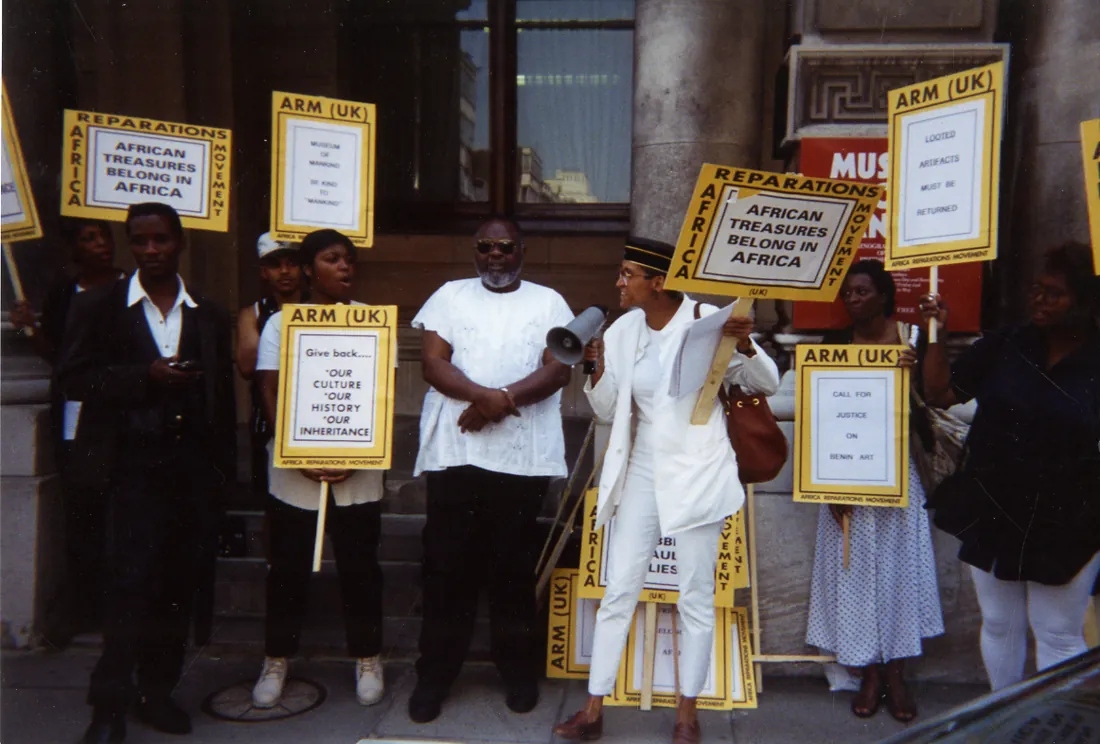
The movement for African Reparations is a broad, longstanding, global movement. Reparations as a term is Latin in origin, meaning to ‘repair’ or ‘restore’. The movement for African Reparations therefore seeks justice for the crimes which have been committed against Africa, Africans and people of African descent over the last 500 years. Reparationists argue for the need to address, acknowledge, and repair the damage caused by European and Western powers, from the infamous human trafficking of enslaved Africans (commomly referred to as the Slave Trade); the Scramble for Africa and subsequent colonisation of the African continent and its people; the psychological, economic and political impacts of racism; the persistence of anti-Black and anti-African racism today; and the insidious presence of neo-colonialism in Africa and the Caribbean.

Campaigns for African Reparations have taken many forms throughout history. In the UK, although reparations-related activism has existed for a long time in anti-racist, Black Power and civil rights movements, it took a more organised form from the late 1980s onwards, as argued by leading Reparationist and scholar Esther Stanford-Xosei . That being said, demands for reparations can be traced all the way back to the eighteenth century in the considerations of abolitionist Ottobah Cugoano in his publication, Thoughts and Sentiments on the Evil of Slavery . Examples of calls for Reparations during the early 20th century include those made by W.E.B Du Bois throughout the series of Pan-African congresses from 1919-1927, and in Marcus Garvey’s request to the League of Nations for the creation of an African State from Germany’s confiscated colonies in the aftermath of the First World War.
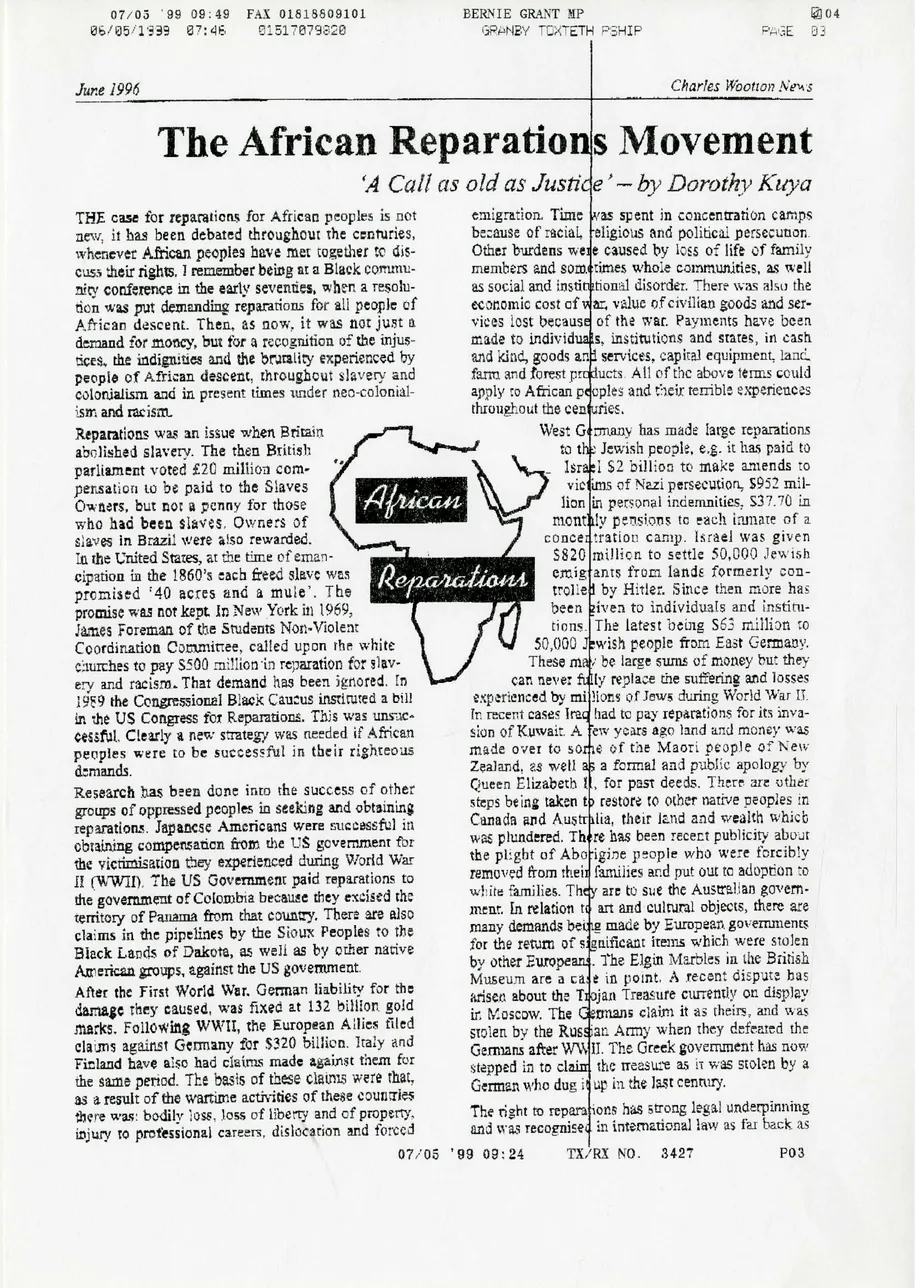
BG_ARM_1_4-The-African-Reparations-Movement-A-Call-as-old-as-Justice-1
This document outlines the foundation and activities of the African Reparations Movement UK (ARM UK), co-founded and chaired by Bernie Grant in 1993 to campaign for reparations for slavery and racism following the 1993 Abuja Proclamation. It is useful for understanding Bernie Grant's role as a political activist dedicated to addressing historical injustices through parliamentary motions and grassroots organizing, highlighting his commitment to Pan-African solidarity and reparations as a means of justice for African and diaspora communities.
Throughout the mid-late 20th century, Civil Rights and Black Nationalist organisations also argued for the need for Reparations, including the Nation of Islam in the 1940s, and the Civil Rights Congress who in 1951 presented the United Nations with a case entitled ‘We Charge Genocide: Relief from a Crime of the United States Government against the Negro People’. Not long after this, in 1955, the Reparations Committee for United States Slaves’ Descendants was founded by Audley Moore, known widely as Queen Mother Moore. This group sought “relief in money damages for the victims of these injustices with which to begin a program of rehabilitation”. The development of the Rastafari movement is a key illustration of ‘unofficial’ Reparations activity, with emphasis on repatriation to Africa in both the physical and spiritual sense. On the African continent, there is also a long history of campaigns for Reparations, notably the work of Nigerian scholar Ekpo O. Eyo, who tirelessly campaigned for the restoration of African artefacts held by museums and private collections in the West.
Arguments for Reparations go far beyond calls for financial compensation, and this is easily proven by examining Britain’s Reparations movement, and Bernie Grant’s pioneering activism in this field. One of the most significant milestones in Britain’s history of organising for African Reparations, was the founding of the African Reparations Movement UK (ARM) in 1993. It was established at the behest of Bernie Grant, who was joined by Linda Bellos, Sam Walker, Stephen Small, Dorothy Kuya and many others. ARM was officially launched at the Birmingham Conference on Reparations held on December 11th 1993 which was entitled ‘What Do Reparations Mean?’. The Birmingham Conference was itself a result of Bernie Grant’s involvement in the First Pan-African Conference on Reparations, held in Abuja, Nigeria, in April of 1993.
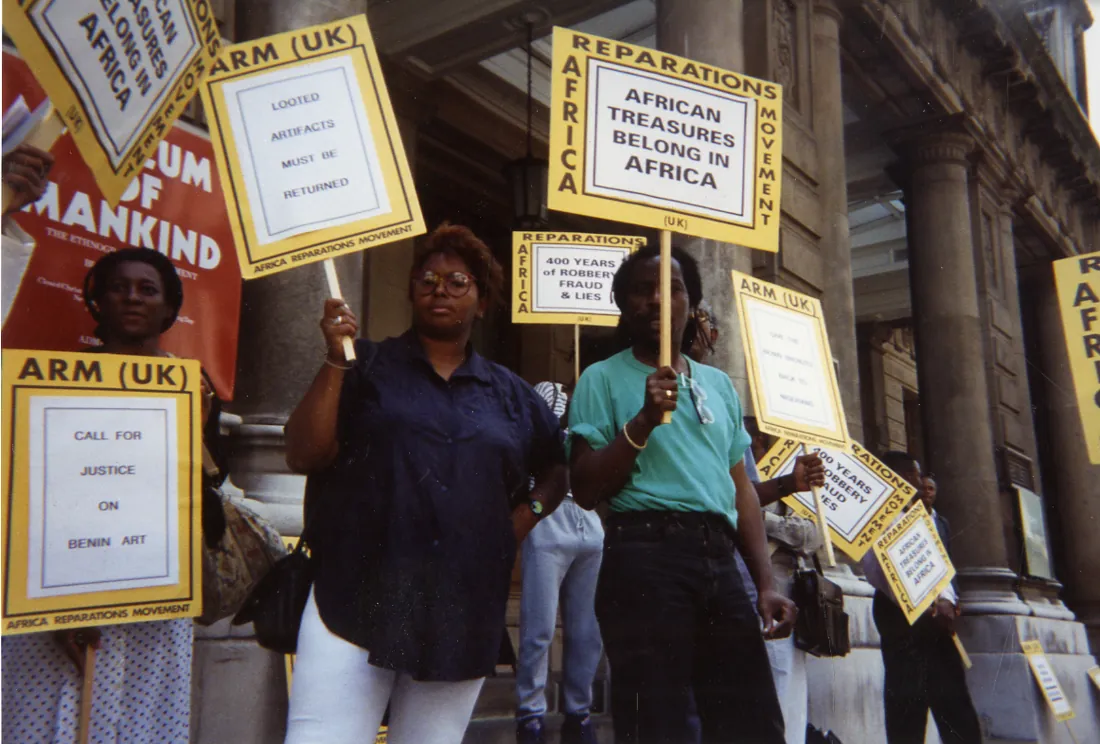
Throughout its lifespan, and under Grant’s chairmanship, ARM took up many issues and topics, and sought to build a substantial movement in Britain to campaign for African Reparations, whilst building and maintaining links with the global Reparations movement. Some of the extensive work of ARM included holding public meetings and events to raise awareness of Reparations, its meaning and importance, conducting research on the impact of slavery, colonialism, and neo-colonialism especially as it pertained to Britain’s involvement, campaigning around education and the inclusion of Black history and heritage, demanding the repatriation of stolen or misappropriated artefacts from Britain’s museums and galleries, and more.
As a Member of Parliament, Bernie Grant tabled an Early Day Motion on 10th May 1993, welcoming the Abuja Proclamation. This Proclamation had been drawn up as a declaration of the First Pan-African Conference on Reparations in Nigeria earlier that year. The Early Day Motion received 63 open signatures from other MPs, and provided publicity and media coverage for the issue of Reparations. Bernie Grant’s individual work around Reparations in his capacity as an MP was interlinked with the work of ARM, which played a vital role in strengthening Reparations-centred activism in Britain, and of course these were interlinked. However, after Grant’s passing in April 2000, ARM ceased activity and the wider Reparations movement in Britain lost a leading figure. Despite this, Grant’s legacy and that of the ARM can be seen in the ongoing Reparations campaigns in Britain, which have been sustained by a number of events, organisations and committees, from grassroots community groups to parliamentary action, and cross-collaborations between the two.
Theme sections
Although the Abuja Conference and its Proclamation is better known and commemorated, the event which facilitated it was the World Conference on Reparations to Africa and Africans in the Diaspora. Like the…
0 document/media itemsTheme sectionPapers Presented at the World Conference on Reparations to Africa and Africans in the DiasporaThe World Conference’s report serves as valuable evidence of the efforts on the part of scholars, activists, governmental officials and politicians, to build an international coalition for African Reparations. It also reflects…
1 document/media itemTheme sectionFirst Pan African Conference on Reparations and the Abuja DeclarationIn April 1993, The First Pan African Conference on Reparations was convened in Abuja, Nigeria. It was sponsored by the Group of Eminent Persons (GEP), the Commission for Reparations of the Organization…
2 document/media itemsTheme sectionAfrican Reparations Movement UKThe African Reparations Movement (ARM) UK served as the foremost national organisation for Reparations in Britain, and through its connection to the Organisation of African Unity, was the UK wing of the…
6 document/media itemsTheme sectionBirmingham Conference on Reparations, ‘What Do Reparations Mean?’The Birmingham Conference on Reparations was convened in December 1993, and served as the official launch of the African Reparations Movement UK (ARM). It formed part of a list of initiatives by…
5 document/media itemsTheme sectionBirmingham DeclarationFollowing the precedent set by the Abuja Conference, the Birmingham Conference culminated in the Birmingham Declaration. This declaration emulated the format and arguments present in the Abuja Proclamation, but sought also to…
1 document/media itemTheme sectionEarly Day Motion and the House of CommonsAs Bernie Grant asserted in ‘Reparations or Bust!’, he had a unique role to play in fighting for Reparations as a Member of Parliament. One of the methods he deployed to utilise…
1 document/media itemTheme sectionLord Gifford and the House of LordsAnother leading figure in Britain’s Reparations Movement during the 1990s was Lord Anthony Gifford. In his capacity as a human rights and social justice lawyer, one of his major contributions was his…
1 document/media itemTheme sectionControversy: Reparations and RepatriationIn early October 1993, Bernie Grant was again the subject of press hysteria, when his statement on the question repatriation for Black and minoritised people in Britain, was misreported. On October 5th,…
0 document/media itemsTheme sectionReparations todayExternal links:
1 document/media itemRelated archive records
These are individual catalogue records connected to this theme.
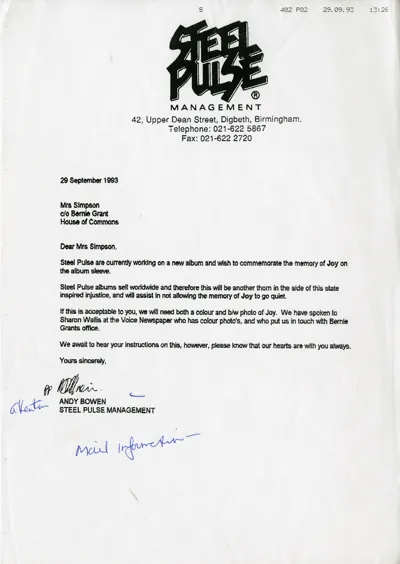
Steel Pulse letter to commemorate Joy Gardner
Reference: BG/ARM/3/1/1
This document is a letter from Steel Pulse's management dated September 29, 1993, addressed to Mrs. Simpson via Bernie Grant's office. The letter expresses…

The Voice; ‘take the money and run’ 5th October 1993
Reference: BG/P/6/1/7
This 1993 article from The Voice features MP Bernie Grant discussing the controversial topic of voluntary repatriation for Black people in Britain. Grant acknowledges…

Scots the Difference? Press release from Bernie Grant
Reference: BG/P/14/2/9
This press release from Bernie Grant, dated December 6, 1996, highlights his call for the return of African artefacts held in British museums. Marking…
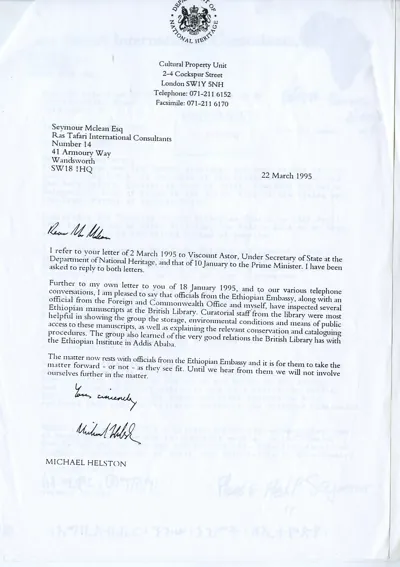
Letter to Seymour Mclean from Michael Heston regarding inspection of Ethiopian manuscripts at British Library
Reference: BG/ARM/16/5/31
This is a letter from Michael Helston of the UK Department of National Heritage to Seymour Mclean of Ras Tafari International Consultants dated 22…
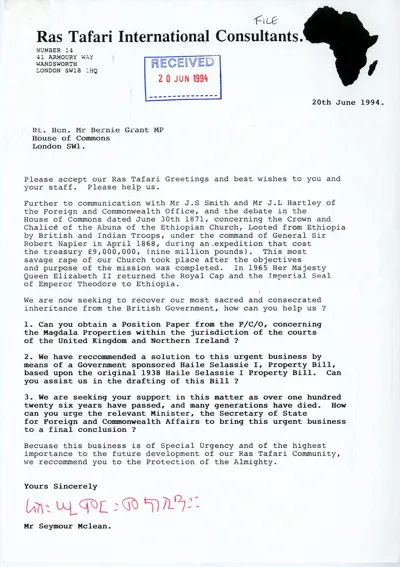
Letter to Bernie Grant from Seymour Mclean regarding Haile Selassie I bill
Reference: BG/ARM/16/5/31
This is a 1994 letter addressed to Bernie Grant MP from Seymour Mclean of Ras Tafari International Consultants. The letter appeals for support in…
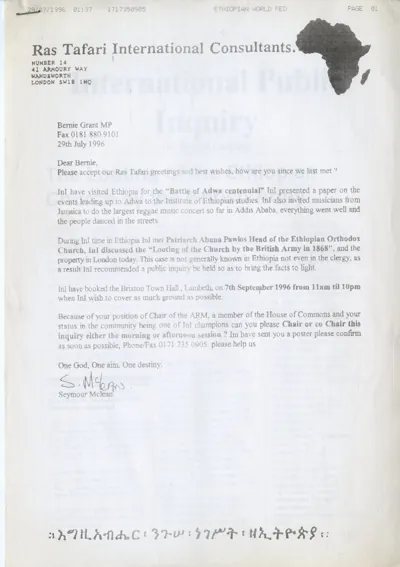
Letter to Bernie Grant regarding visit to Ethiopia
Reference: BG/ARM/16/5/31
This is a letter dated 29 July 1996 from the Ethiopian World Federation to Bernie Grant MP. It discusses a recent visit to Ethiopia…
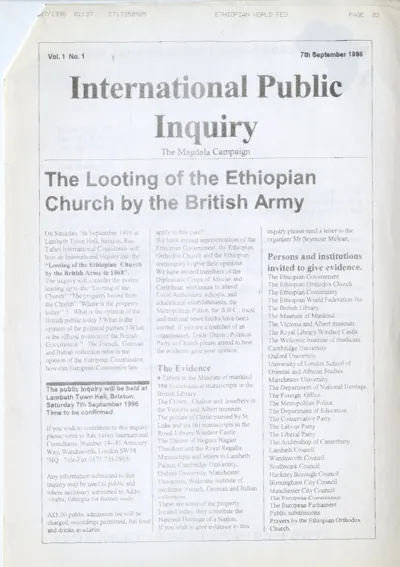
International Public Inquiry: the looting of the Ethiopian church by the British Army
Reference: BG/ARM/16/5/31
This document announces an International Public Inquiry held in 1996 at Lambeth Town Hall to investigate the looting of Ethiopian Church treasures by the…
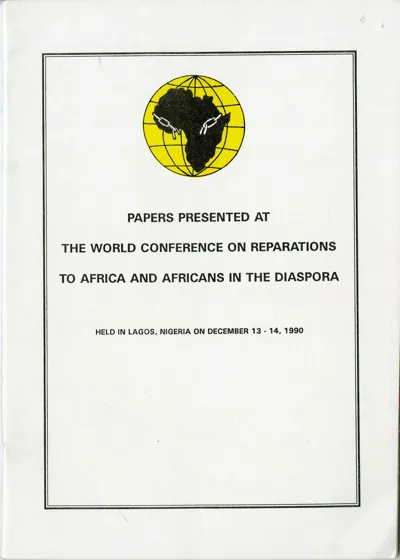
Papers presented at the world conference on reparations to Africa and Africans in the diaspora
Reference: BG/ARM/5/1/1
This document contains papers presented at the World Conference on Reparations to Africa and Africans in the Diaspora, held in Lagos, Nigeria, in December…
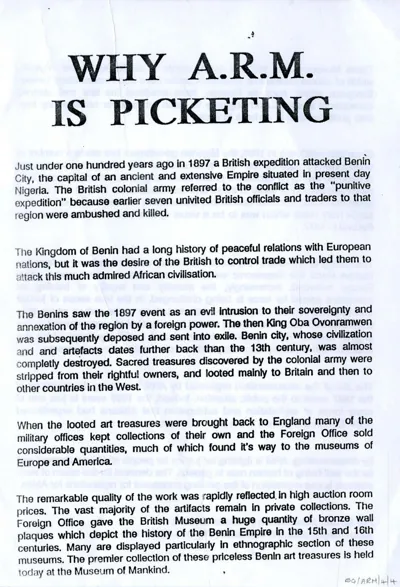
Why ARM is picketing
Reference: BG/ARM/4/4
This document explains why the African Reparations Movement (A.R.M.) is picketing, focusing on the 1897 British invasion of Benin City in present-day Nigeria. It…
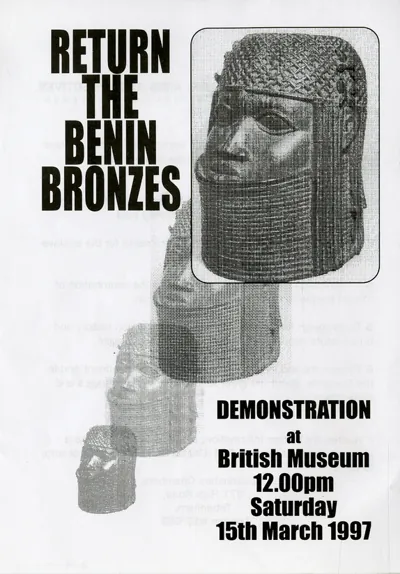
Return the Benin Bronzes
Reference: BG/ARM/4/4
This document is a flyer announcing a demonstration calling for the return of the Benin Bronzes to Nigeria. The protest was scheduled to take…
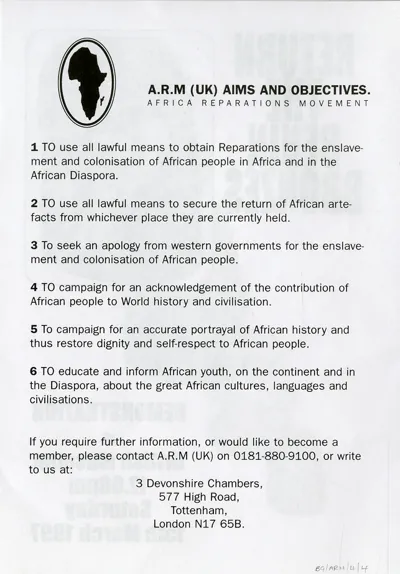
ARM aims and objectives
Reference: BG/ARM/4/4
This document outlines the aims and objectives of the Africa Reparations Movement (ARM) in the UK. ARM is an organisation dedicated to seeking reparations…
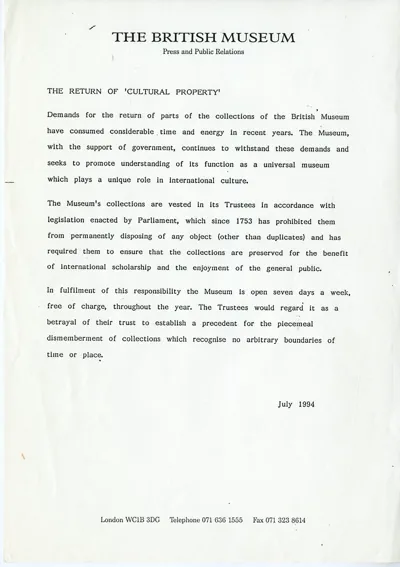
The British Museum PR ‘The return of ‘cultural property”
Reference: BG/ARM//16/5/27
This document is a 1994 statement from the British Museum's Press and Public Relations office addressing ongoing demands for the return of cultural property…
