
Back to Politics: Black Sections, the First Black MPs, and the Parliamentary Black Caucus
Parliamentary Black Caucus and Rainbow Coalition
Britain’s new Black MPs, bolstered by Bernie Grant’s international connections, took pointers from their counterparts in the United States and established the Parliamentary Black Caucus (PBC) in 1988. Modelled on the US Congressional Black Caucus, the PBC was founded at the behest of Grant, with the involvement of new Black MPs, Keith Vaz, Diane Abbott and longstanding Labour and Civil Rights figurehead Lord David Pitt. Paul Boateng declined to join. Lord Pitt, originally from Grenada and only the second Black peer in the House of Lords. He had been involved in anti-racist movements, and the Labour movement in Britain, since the 1940s, and belonged to the generation which preceded Grant and his comrades in Black Sections.
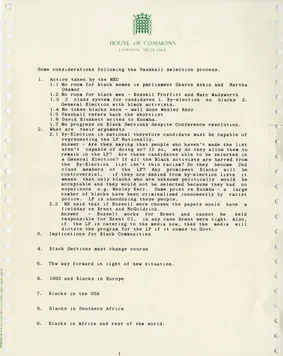
BG_PBC_4_7
This document is a letter from Councillor Franklyn Georges and the Parliamentary Black Caucus to Rt. Hon. Neil Kinnock in 1989, expressing strong opposition to the Labour Party National Executive Committee's (NEC) imposition of a white candidate for the Vauxhall by-election despite the constituency's significant black population and local black candidates' support. It is useful for understanding Bernie Grant’s campaign context and broader themes of racial representation and party politics within Labour, highlighting tensions around black political empowerment and criticisms of institutional insensitivity.
Their collaboration in the form of PBC was a nod to the continual and intergenerational struggle for Black representation in British politics. Grant acted as chairperson for the PBC, and the group’s work reflected his political outlook. As an MP, Grant took a deep interest in the situation in Europe, and the state of racism throughout the continent. He was concerned, as others were in the international socialist movement, with the role of the European Union in immigration, customs and trading policies, and the potential for adverse effects for African, Caribbean, and South American countries. For instance, a PBC meeting held on 7th March 1989, welcomed Sir Julian Hunte as the group’s special guest.
Hunte, then leader of the opposition Labour Party in St Lucia, addressed the PBC on the issue of the Windward Islands’ banana exports. Banana exports constituted 90% of St Lucia’s overall exports trades, and the European Union’s Single European Act of 1986 threatened the Caribbean region with a 40% unemployment rate as a result. The PBC were therefore concerned with the fate of the Caribbean in this instance.
In October 1989, Grant, Vaz, Abbott and Lord Pitt were invited to the 19th annual conference of the Congressional Black Caucus in Washington D.C. which was attended by over 20,000 people. This event led Grant to aspire to an international umbrella organisation for Black governmental members across the globe: “I think an international caucus could be set up”, he stated to The Voice newspaper, “Individual members can work for their countries, while together we can work for global issues”.
Alongside its internationalist focus, PBC also spoke out about issues related to Britain’s Black Community. Students from the London School of Economics voted to make Winston Silcott of the ‘Tottenham Three’, their Honorary President, in solidarity with his and other Broadwater Farm Residents’ ongoing battle for justice in the aftermath of the 1985 Uprising. The students were subsequently attacked in the Press and by Conservative politicians. The PBC, in defence of the students, released a statement in April 1989: “The London School of Economics students have selected Winston Silcott as their honorary president, because they believe that he is not guilty and that a grave injustice took place, many international organisations including Amnesty support this view”.
Parliamentarian Magazine [BG_PBC_5_2] Download
Alongside its campaigning and special interests, the PBC also published a magazine called The Black Parliamentarian , from Grant’s Tottenham office This was an attempt to bring an understanding of Parliament and its potential to a community to date unfamiliar with such issues. A first issue of this, published in Autumn 1989, can be found in the Bernie Grant Archive collection, this particular copy having been signed by various supporters. The Black Parliamentarian has contributions from Diane Abbott, Lord Gifford, Dorothy Kuya, Bill Morris, Narendra Makanji, Ansel Wong, Sean O’Donovan, Peter Herbert, Sam Ramsamy, Keith Vaz, Manny Cotter, B.R.O.T.H.E.R, Mickey Leland, and other such community organisers, political figures and activists. The magazine folded however when a major donor hit financial problems. The PBC itself was, however, disbanded in 1991, as members had varying levels of commitment to the project. Similarly to the Parliamentary Black Caucus, the idea of formation of the Rainbow Coalition UK was connected to Grant’s ties with Black political figures across the pond. Throughout the late 1980s into the 1990s, Grant maintained a rapport with US congressman and Civil Rights icon Jesse Jackson and held out hope of building international links between black politicians – despite having little by way of resources to develop a suitable infrastructure for such a considerable undertaking. He did however set up an Organisation for Africans in Europe, and a Standing Conference on Race Equality in Europe (see elsewhere) but from 1993, his efforts to build the African Reparations Movement took precedence.
In 1971, Jesse Jackson had founded the National Rainbow Coalition with its headquarters in Chicago, and branches across the US. It was based on the idea of coalition, allyship and collaboration between social justice movements. It was, perhaps, an ode to the Rainbow Coalition concept being developed by Black Panther Chicago branch leader Fred Hampon, before his assassination. Grant therefore considered the potential for establishing a Rainbow Coalition in the UK that would facilitate unity and collaboration between different established political movements advocating for oppressed and marginalised sections of society. This included anti-racist, gay, disabled, women’s, workers, prisoners, refugees, young people’s movements, and more. Despite its ambitious aims, it was a dream was displaced by other priorities and was short-lived initiative.
