Back to Politics: Local and Central Government
Positive Images
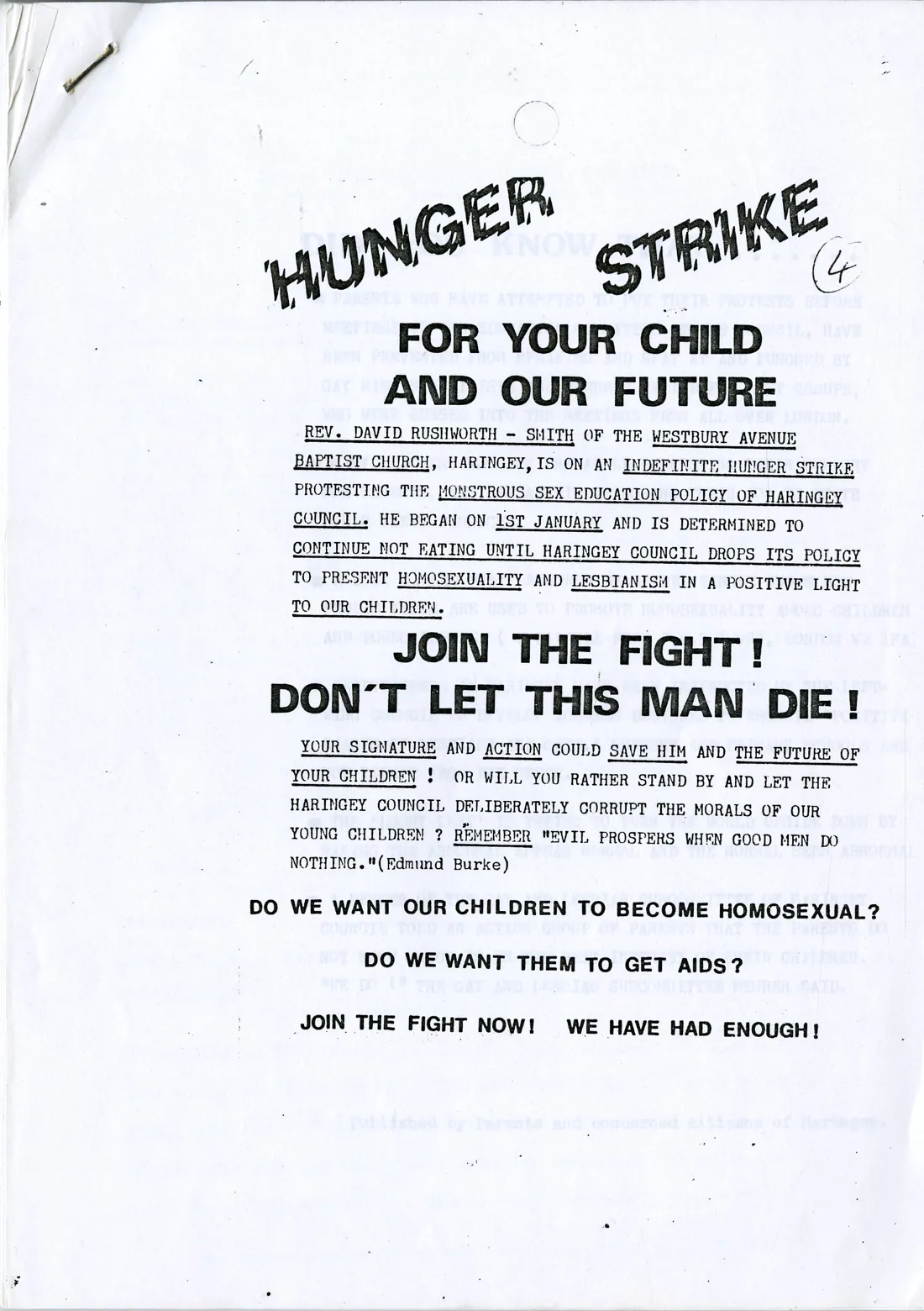
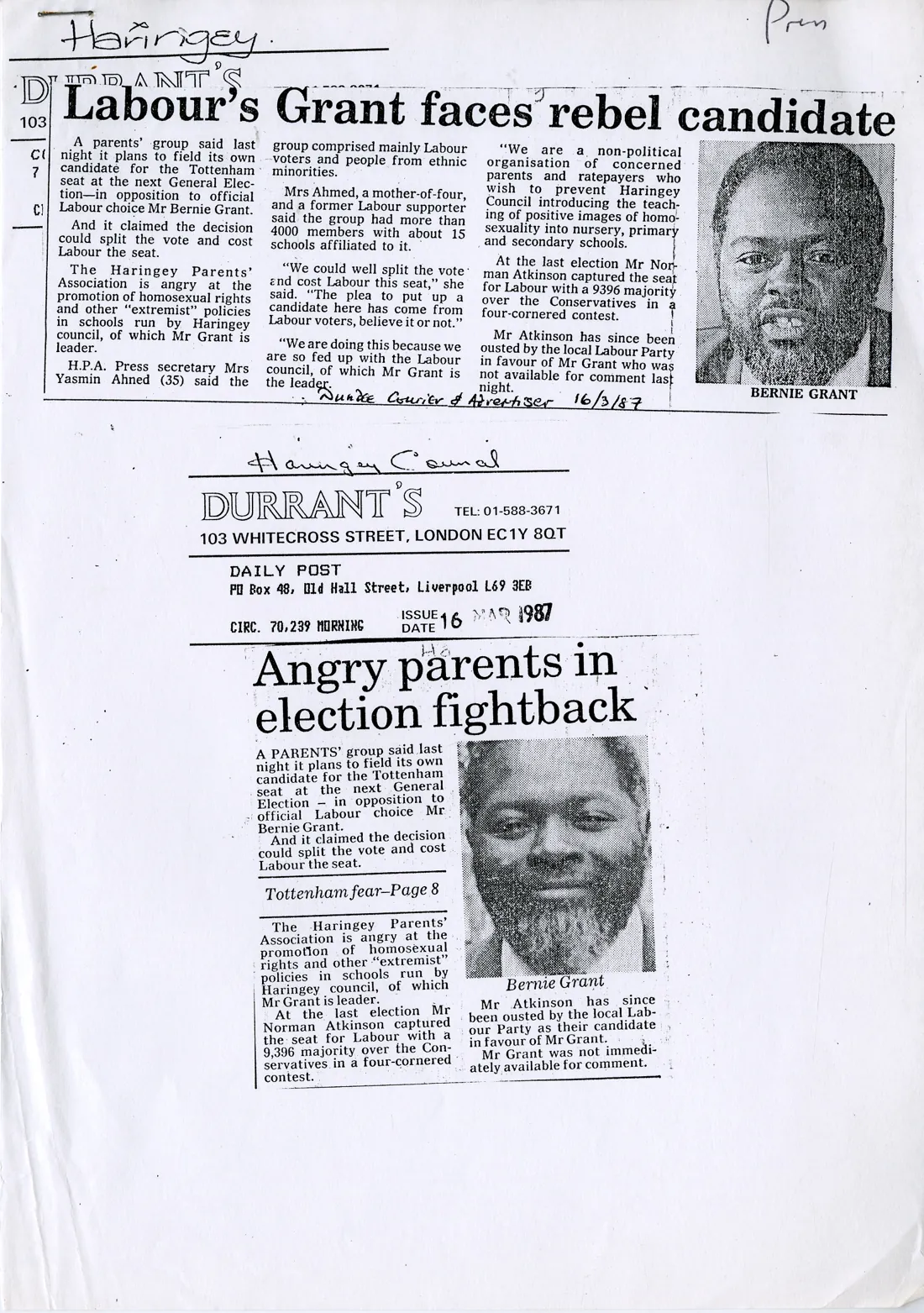
In 1986, Haringey Council launched a Positive Images policy in schools, to challenge the discrimination and homophobia experienced by lesbian and gay people. This initiative included representation of gay and lesbian people who had made significant contributions in British history, combatting homophobic attitudes and promoting equality. A progressive step, Positive Images received a great deal of homophobic backlash, from a wide range of people. A local Reverend announced he was going on Hunger Strike until the Positive Images initiative was repealed, and the Haringey Black Pressure Group on Education even published a press statement in November 1986, claiming the policy was both ‘anti-heterosexist’ and ‘racist’. A letter addressed to Grant and signed by concerned members of the lesbian and gay community, condemned the reactions of local groups such as the Parent’s Action Group and the Black Pressure Group, and demanded that members of the council stand up for the Positive Images initiative by publicising and implementing their own policy. The Parents Action Group, angry at the “promotion of homosexual rights”, even made attempts to field its own candidate to stand against Grant in the 1987 general election, after he was chosen by Labour to stand for the Tottenham constituency.
BG_P_4_3_2 Black Education Pressure Group
This document contains papers presented at the 1990 World Conference on Reparations to Africa and Africans in the Diaspora, detailing the legal, historical, and moral foundations for reparations claims against nations enriched by slavery and colonialism. It is useful for understanding Bernie Grant’s activism and the broader reparations campaign by providing context on the international reparations movement, key arguments, and precedents that informed the struggle for justice and equity for people of African descent.
There existed a great deal of misunderstanding (much of it deliberately provoked by the media) surrounding what the policy would consist of, with some members of the public believing that schools were attempting to indoctrinate children into becoming gay. After a particularly fictitious article was published in The Mirror newspaper, Haringey Council wrote to express its outrage and corrected the article’s fabrications, which included claims that the council had banned references to family life and the word ‘family’ in schools, that 284 of 300 pupils of a local school had stayed home due to a parents’ strike over the initiative, that the council had written to striking parents demanding their children return to school and that teachers were being questioned on whether they were teaching about sex in line with the initiative. In reality, the council had merely set up a Curriculum Working Party which developed guidelines for schools, with input from parents. As a result, The Mirror printed a correction in a later issue.
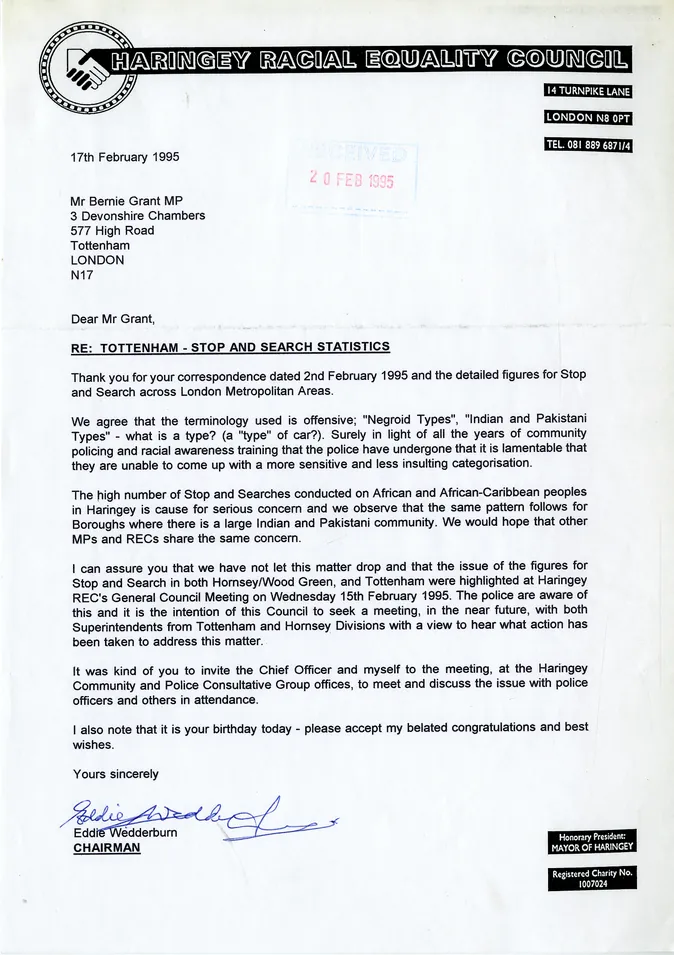
BG_P_4_3_2 Letter to Haringey Council over gay backlash (1)
This document is a letter from Eddie Wedderburn, Chairman of the Haringey Racial Equality Council, responding to Bernie Grant MP’s concerns about racially biased Stop and Search statistics and offensive police terminology targeting African, African-Caribbean, Indian, and Pakistani communities in Haringey. It is useful for understanding Bernie Grant’s active role in challenging racial profiling and his collaboration with local equality groups to address police practices and advocate for community rights.
Grant made attempts to clarify what Positive Images entailed, including during a radio interview in 1987 where he stated that “we will be putting forward Positive Images of gay people so that in history the contributions that gay people have made to society will be spelled out to children. We will also be looking at protecting gay people. They have every right to be protected like every other section of society”. Despite the hysteria surrounding Positive Images, it was an important step in the fight for equality for LGBT+ people, and other marginalised groups.
This policy was launched at a time of rampant homophobia and two years later, Thatcher’s government passed Section 28 of the Local Government’s Bill, a series of laws which banned the promotion of homosexuality by local authorities. It was just the kind of Positive Images initiative by Haringey Council that Section 28 sought to prohibit. During the drafting stage of this legislation in 1987, which coincided with Grant’s first year as an elected MP for Tottenham, he ‘stuck his head above the parapet’ in denouncing the proposals in Committee hearings, stating that it was “merely a device to attack the rights of a minority in society”.