
Archive item
The Runneymede Bulletin: Who, where and why
About this item
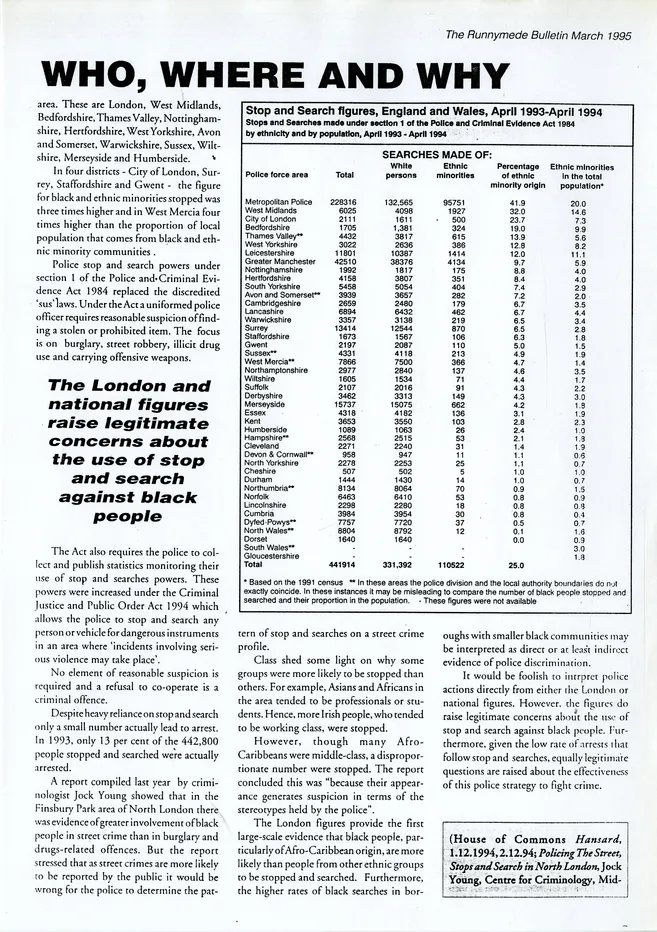
This document, 'The Runnymede Bulletin: Who, where and why' from March 1995, presents detailed data and analysis on police stop and search practices across England and Wales. It highlights significant disparities affecting Black and ethnic minority communities, especially in areas like London and the West Midlands. The bulletin examines the use of stop and search powers under specific legislation and raises critical concerns about racial profiling and policing effectiveness.
Key points:
– Black and ethnic minority individuals were stopped and searched at rates disproportionately higher than their share of the local population, especially in areas such as the City of London, Surrey, Staffordshire, and Gwent.
– Stop and search powers under section 1 of the Police and Criminal Evidence Act 1984 require reasonable suspicion but were expanded under the 1994 Criminal Justice and Public Order Act to allow stops without suspicion in areas prone to serious violence.
– Despite many stop and search incidents, only 13% of those stopped in 1993 were actually arrested, questioning the effectiveness of this police tactic.
– Criminologist Jock Young’s report found that Black people, particularly Afro-Caribbeans, were more often stopped due to police stereotypes rather than evidence of higher involvement in certain crimes.
– The bulletin provides early large-scale evidence of racial disparities in policing, raising concerns about discrimination and the strategy's impact on Black communities.
'The Runnymede Bulletin' intersects with Bernie Grant's legacy as a champion against racial injustice and oppressive policing. The racial profiling and discriminatory stop and search practices detailed here resonate with broader Black British struggles in the 1990s for fair policing, community rights, and accountability. This document contributes to understanding the systemic issues activists like Grant sought to address in local government and national debate about anti-racism and justice.
Source note: The OCR transcript contains some minor errors and incomplete sentences, reflecting the quality of the scanned source. Interpretations focus on clearer, corroborated data points and avoid conjecture where the text is fragmented.
Archive Metadata
