
Archive item
Sam Uriah Morris Society
About this item
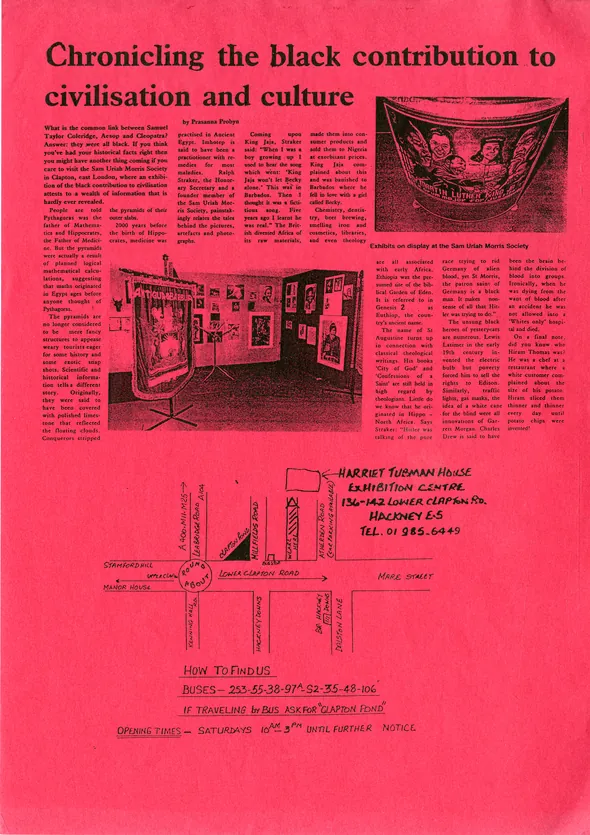
The Sam Uriah Morris Society in Clapton, East London, hosts an exhibition highlighting the overlooked contributions of Black individuals to global civilisation, science, and culture. It challenges common historical narratives by presenting evidence of significant Black achievements across fields such as mathematics, medicine, theology, and invention. This document details the themes and exhibits of the Society, illustrating its role in educating the public about Black history and heritage.
Key points:
– The exhibition asserts that many figures traditionally credited for inventions or discoveries, such as Pythagoras and Hippocrates, have precursors or origins in ancient African civilizations like Egypt.
– It highlights African contributions including advanced mathematics used to build the pyramids, early medicine practiced by Imhotep, and theological works by St. Augustine, who hailed from North Africa.
– The Society recounts stories of Black historical figures like King Jaja of Nigeria, inventor Lewis Latimer, innovator Garrett Morgan, and blood transfusion pioneer Charles Drew, emphasizing their achievements and struggles against racial discrimination.
– The exhibition refutes racist ideologies, noting that Black individuals like St. Morris are revered saints, contradicting notions of racial purity espoused by figures such as Hitler.
– Visitors are provided with practical information about the Society’s location, opening hours, and transport options to access the exhibition centred at the Harriet Tubman House in Hackney.
The Sam Uriah Morris Society embodies the broader movement within Black British politics and anti-racist campaigning to reclaim and promote Black history and heritage. By highlighting global African contributions and revealing racial injustices, it connects to themes of local government cultural activism, internationalism, and the pursuit of equality that informed Bernie Grant’s work and the legacy of Black British political history.
Source note: The text is derived from an OCR transcript that contains some typographical errors and fragmented sentences. Care has been taken to interpret the content accurately and respectfully, but some phrases may be incomplete or unclear due to source quality.
Archive Metadata
