
Back to Challenging oppressive policing
Broadwater Farm 1985 Uprising
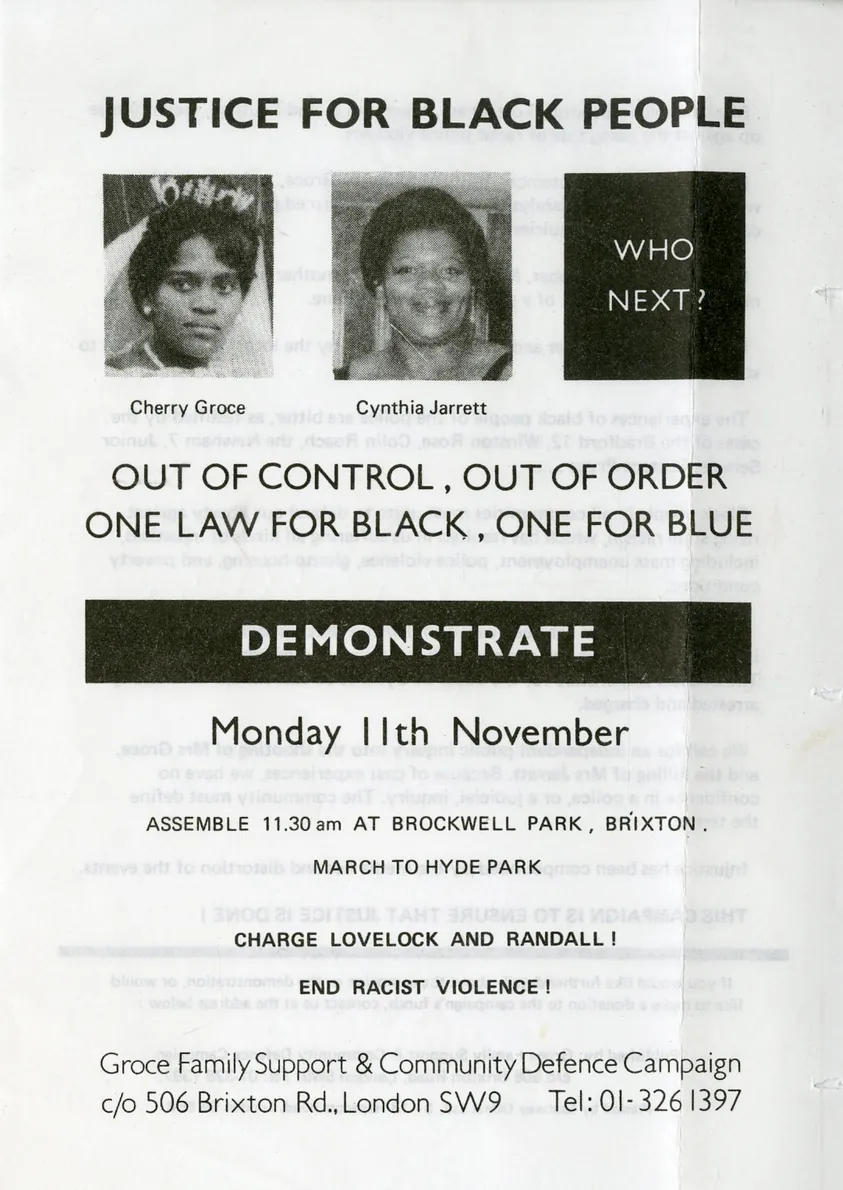
BG_P_4_7_6 justice for black people (1)
This document is a campaign flyer produced by the Groce Family Support & Community Defence Campaign, demanding justice for Cherry Groce and Cynthia Jarrett, both victims of violent police raids that sparked community uprisings in 1985. It is valuable for understanding Bernie Grant’s broader activism context, as it highlights community resistance to racist police violence and calls for accountability and independent public inquiry, reflecting key themes of social justice and black community defense during that era.
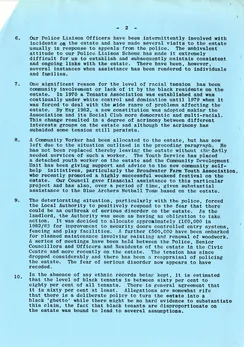
BG_P_4_7_6 Haringey Community Relations Council
This document is a 1982 report from the Haringey Community Relations Council detailing the social and racial tensions on the Broadwater Farm estate, highlighting issues with police relations, community involvement, and housing policies. It is useful for understanding the challenges Bernie Grant and related campaigns faced in addressing systemic inequalities, racial tensions, and community development on the estate.
On 6th October 1985, the Broadwater Farm estate in Tottenham was the scene of a major youth rebellion, sparked by young people’s frustration and anger at police violence. As in other civil uprisings, the ‘85 Uprising was triggered by a specific incident. On 5th October, Cynthia Jarrett, a 49-year-old local mother, suffered a fatal heart attack when her home was raided by police officers. Around 5 hours before this raid took place, her son Floyd Jarrett had been falsely arrested for a ‘suspicious’ car tax disc, and charged with theft and assault. He was later acquitted of all charges. Far from being isolated incidents, Mrs Jarrett’s death and her son Floyd’s wrongful arrest symbolised levels of harassment which had become commonplace experiences for residents of Broadwater Farm and the surrounding areas. When news spread of Mrs Jarrett’s death, members of the local community were outraged, and young people felt they couldn’t take any more. They took to the streets to physically challenge the police behaviour. This led to the most serious riots ever in mainland Britain in which a policeman, PC Blakelock was stabbed to death. It’s important to note that just 7 days prior to the uprising at Broadwater Farm, Brixton had similarly erupted after the police shooting of Cherry Groce. Ms Groce was a local Black mother who was shot by police and paralyzed from the chest down, during a raid on her home where three of her children were present. As they would then do at Broadwater Farm, young people in Brixton took to the streets in anger against police brutality. In the space of just one week, two Black mothers and their families had been victims of police violence in London, pushing local young people to react. Alongside these events in London, Handsworth in Birmingham had been the centre of an uprising against police harassment, between the 9 th -11 th September. Just several years prior in 1981, there had been widespread rioting in Brixton, Bristol, Toxteth, Moss Side and Chapel Town all as a result of rampant police harassment. The Broadwater Farm Uprising was therefore part of a wider pattern of resistance toward incessant, oppressive policing in inner city, predominantly Black communities and working-class areas. As organisers of a march in memory of Cynthia Jarrett and Cherry Groce asserted, the situation was “out of control, out of order. One law for black, one for blue”.
Reflective of this national context, insofar as the local situation was concerned, the problems which faced Broadwater Farm estate went much further back than 1985, and were broader than just oppressive policing. Broadwater Farm represented the general neglect of inner-city neighbourhoods by the state in the postwar period. Originally opened in 1970, the conditions on the estate were already inadequate by the mid-1970s. Unfair housing allocations policies are believed to have resulted in highly concentrated communities of disadvantaged residents with no other choice but to accept housing here. The poor conditions experienced by residents led to frustration and tensions within the community. Increased instances of burglary, vandalism, and displays of racism including the appearance of swastikas, led to increased police presence.
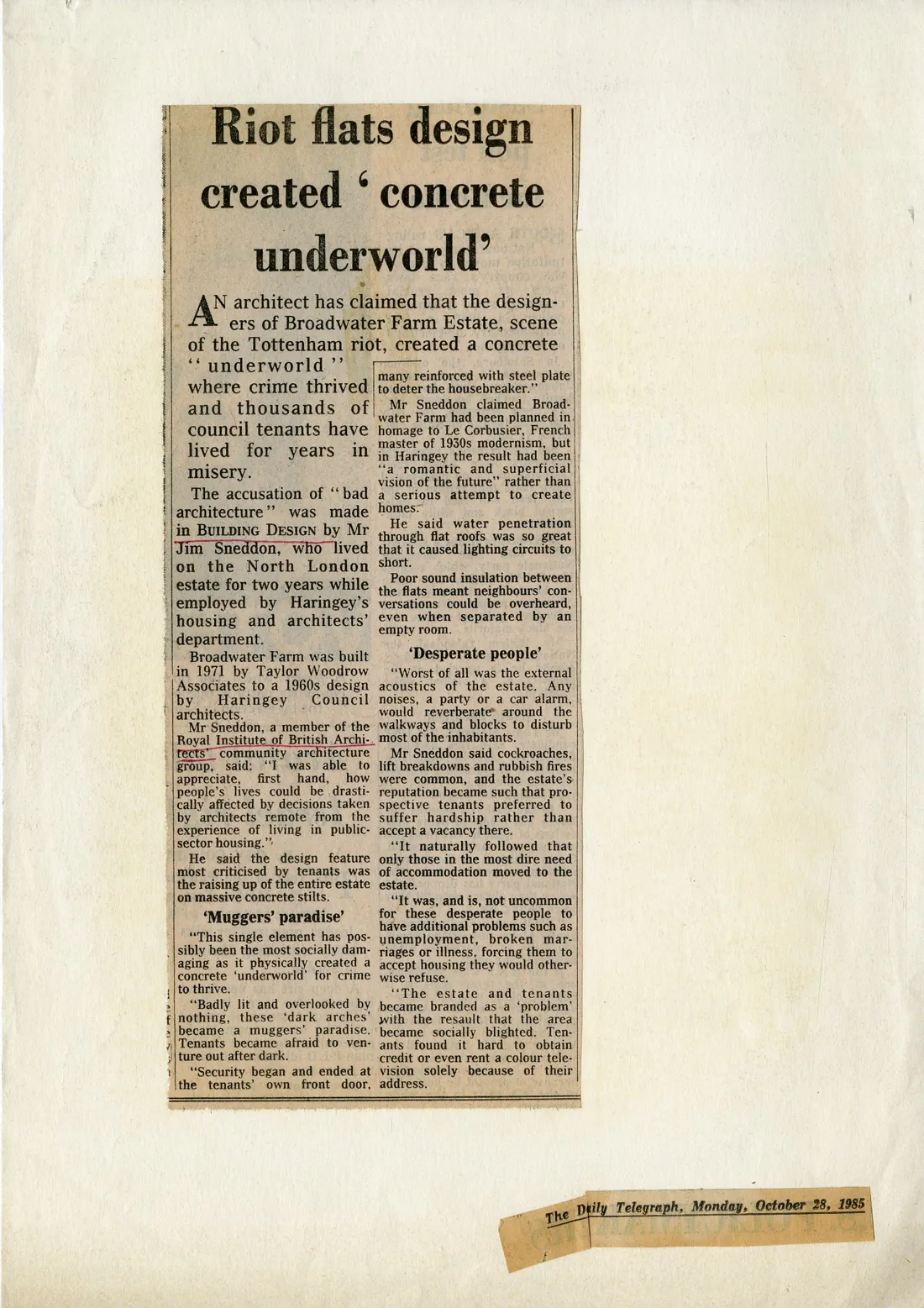
But the methods deployed by the police, which were overtly confrontational, only hastened the deterioration of the relationship between the residents and police force. Not only that, but the reputation of the estate led to residents being discriminated against. One newspaper reported on the links between the estate’s flawed design and social problems, pointing to instances wherein residents had trouble gaining employment or even renting a coloured television due to their home addresses. The 1985 Uprising was not the first time that residents of the Farm, and local community, sought to assert their rights and challenge their oppressed conditions. The Farm was host to various projects, including the Broadwater Farm Tenants Association, Broadwater Farm Youth Association and Co-Operative. Haringey Council had, in addition to these community-run groups, highlighted the systemic problems present on the Farm and had invested in various initiatives and repair projects to mitigate the negative conditions. These entities were all aware of the root causes of the problems on the estate, and the less than helpful attitudes of the police. The Youth Association, for example, expressed that it was common knowledge that Tottenham Police Station had maps of the estate, with markings showing how, “should anything happen, they will take the estate”. Young people also reported that police officers had made attempts for several years to spread rumours of an impending riot every summer, despite there being no historic precedent for such an event on the Farm.
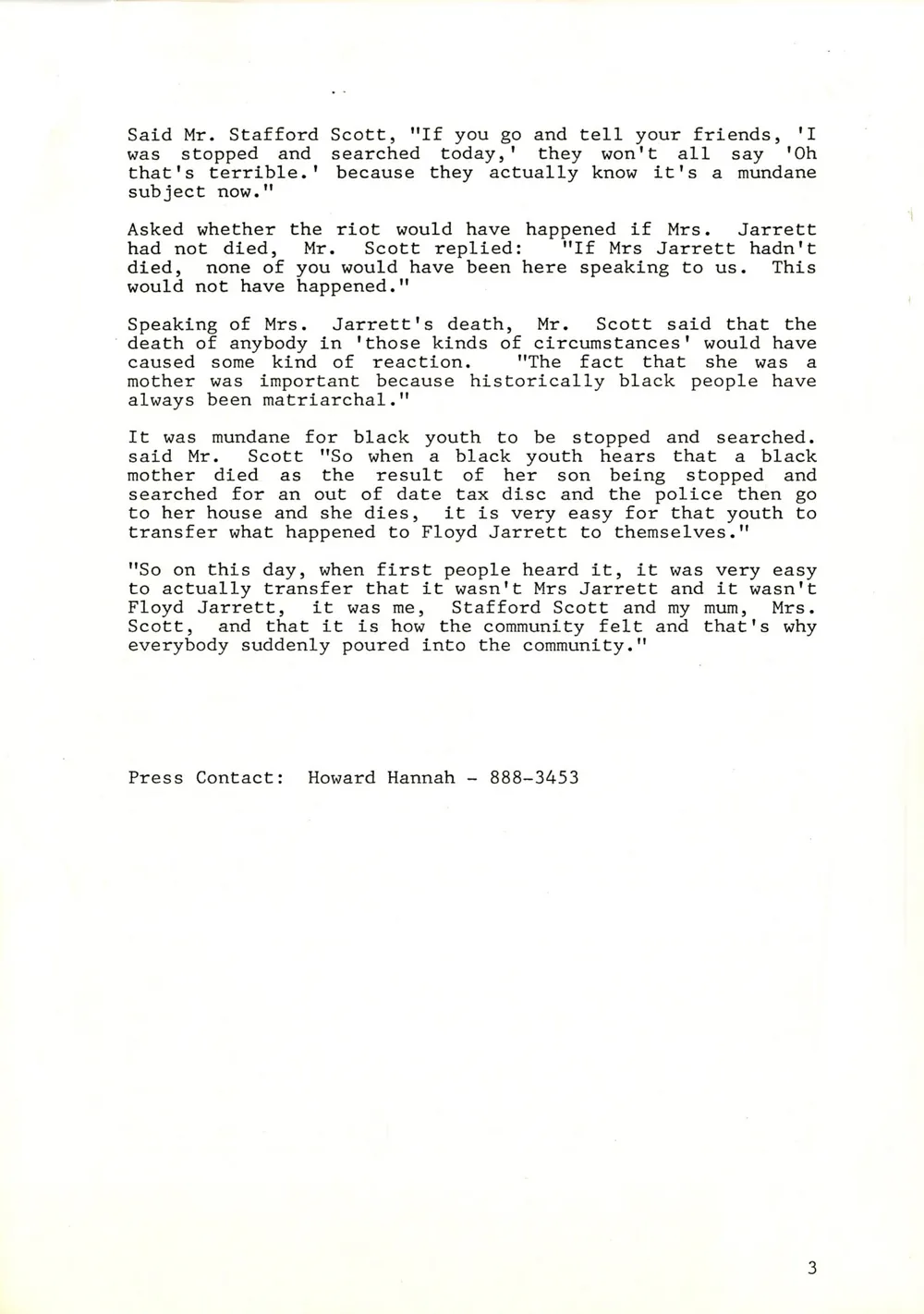
BG_P_4_7_6 police staged 'practice run'
This document is a press release from the Broadwater Farm Inquiry in 1986 detailing police preparations for a riot at Tottenham's Broadwater Farm Estate, including a staged "practice run" and widespread police intelligence suggesting unrest despite a lack of evidence. It is useful for understanding the context of racial tensions and policing strategies leading up to the Broadwater Farm riot, highlighting community perspectives on police anticipation of conflict and the impact on Black residents, which informed Bernie Grant’s activism and campaign focus.
During the course of the Broadwater Farm Uprising, approximately 500 young people filled the estate and clashed with police. Police Officer Keith Blakelock was killed, in what remains an unsolved murder. This tragic outcome of the Uprising contributed to the extremely biased and heavily racist press coverage that the event garnered. From the beginning of the investigation into Blakelock’s murder, it was clear that all usual rules regarding police conduct were abandoned, and, as is documented in various sources, there followed gross abuse of civil rights. This led to the arrest of numerous young Black men and boys, one as young as 12 years old, in the days that followed. It was soon revealed that some of the young people arrested were held for a total of 5 days before being either charged or released, others had their clothes taken away and were left without shoes, and minors were denied access to their parents, a social worker or adult to act in their interests during questioning. However, since the PACE Act was passed in 1984, police were not permitted by law to detain people more than 24 hours without charge or releasing them on bail . Thirteen year old , Jason Hill, was arrested alongside his entire family during a dawn raid on his family home. He was detained for three days, denied access to an adult representative, interrogated in just his underwear and a blanket, and forced to make a false confession. The officer in charge of the investigation, DCS Melvin, was disciplined a mere five years after the events in 1990.
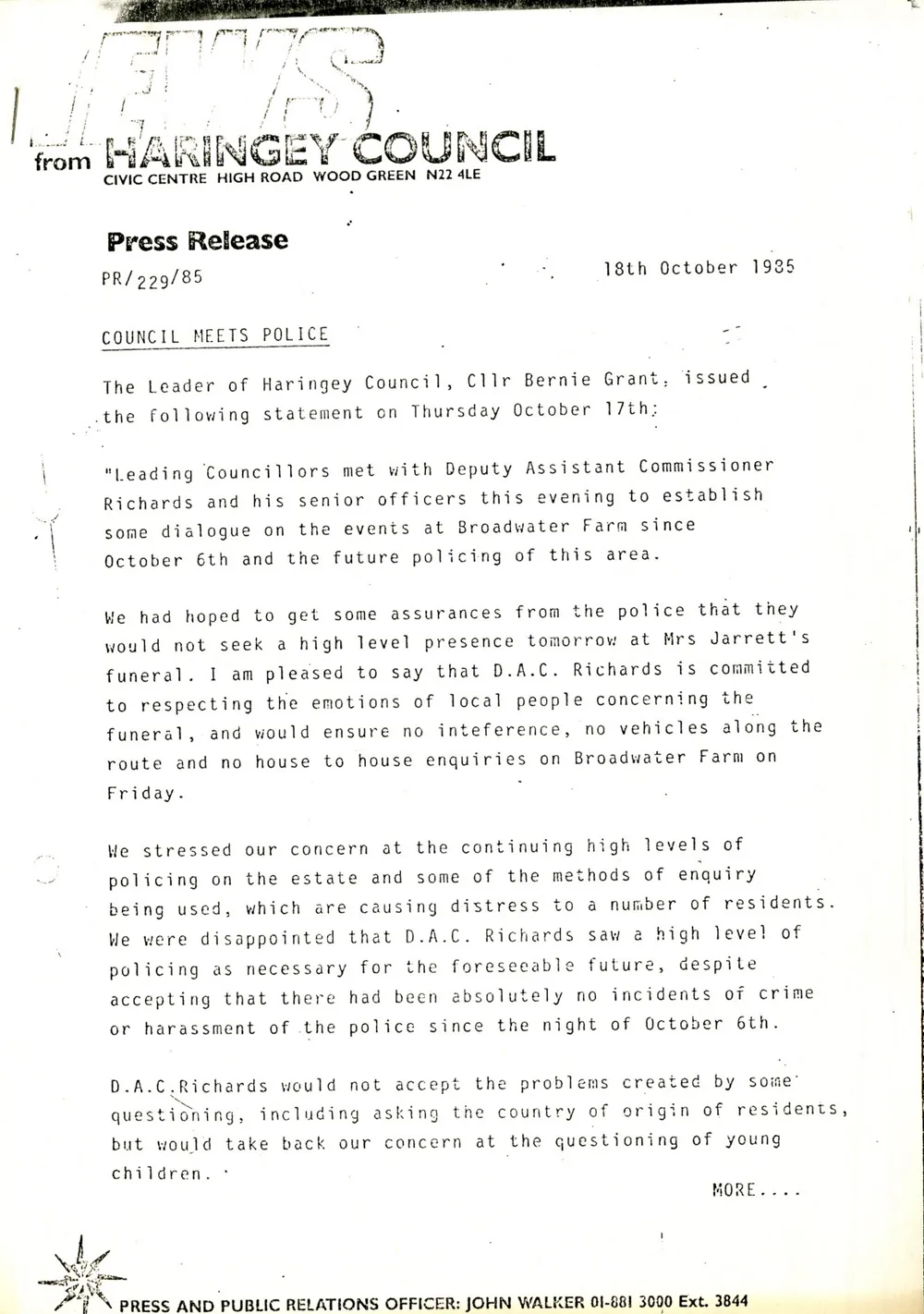
BG_P_4_7_6 Haringet Council press release
This archive document contains Haringey Council press releases from October 1985 detailing local political responses, including statements by Council leader Bernie Grant, to policing actions and community relations following the Broadwater Farm riots. It is useful for understanding Grant's role in advocating for better police-community dialogue, highlighting concerns over police methods, especially relating to juvenile detainees, and illustrating council efforts to address civil rights and social justice issues during the campaign.
Bernie Grant had been elected leader of Haringey Council in that same year as the uprising took place, making him the first ever Black council leader in Europe For some years prior to this however he had worked with residents on the estate, as its local councillor, to resolve its problems. Unsurprisingly therefore, Grant was the central spokesperson for Broadwater Farm residents at this time of heightened media attention and scrutiny. In the immediate aftermath of the uprising he was intentionally taken out of context by the press eager to vilify him. It was reported that he’d said “The police were to blame for what happened on Sunday night and what they got was a bloody good hiding”. What he had actually said was that “the youth think they gave the police a bloody good hiding”, in an attempt to convey the views of the young people who had risen up in anger at ceaseless police harassment.
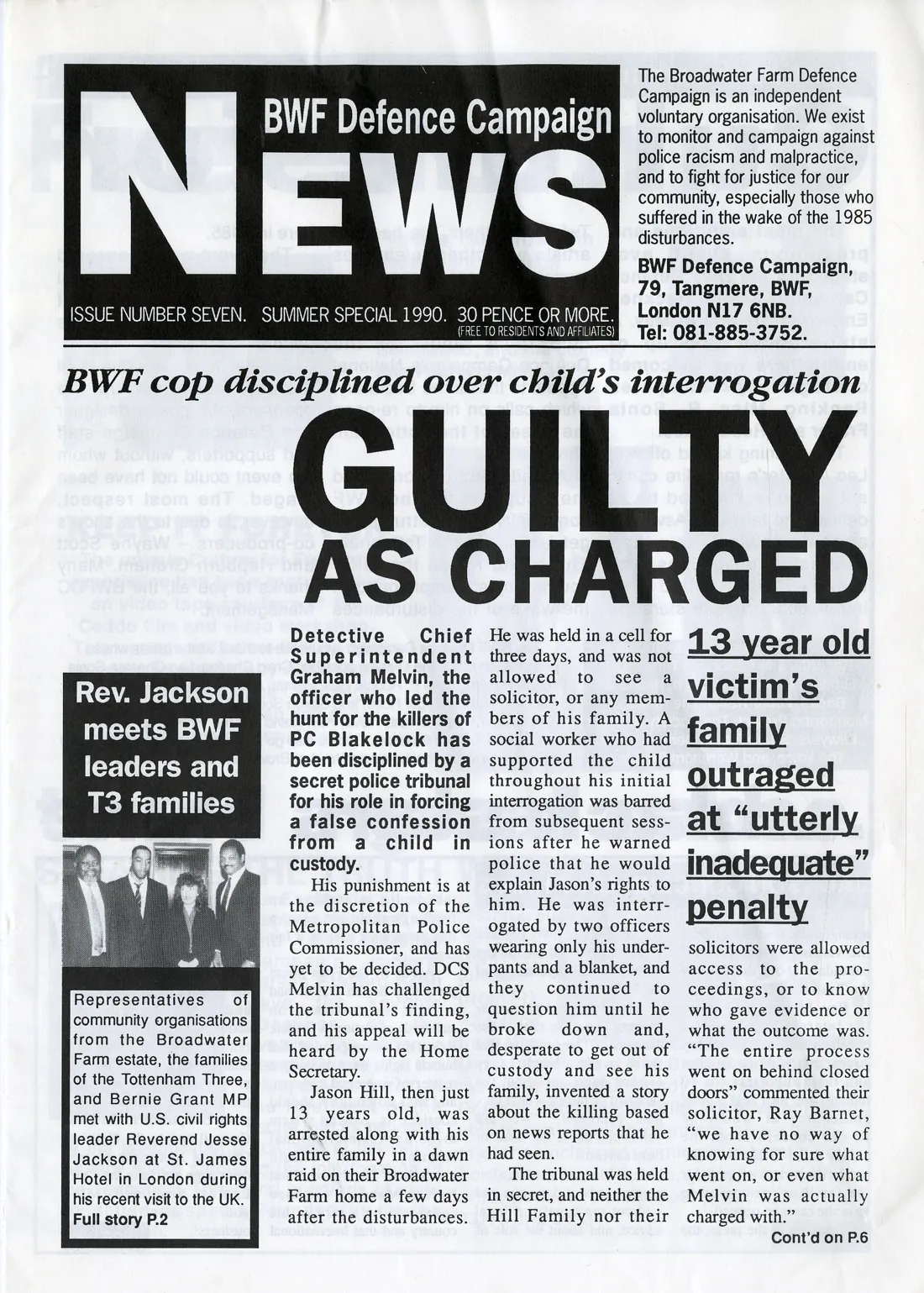
BG_P_2_1_8
This document contains papers presented at the 1990 World Conference on Reparations to Africa and Africans in the Diaspora, discussing the legal and historical basis for reparations claims related to slavery and colonialism. It is useful for understanding Bernie Grant's campaign context as it highlights the reparations movement's emphasis on justice, historical evidence, and global precedents, framing reparations as a central theme in the fight against racial and economic injustice.
This misquote would follow Grant for the rest of his political career, and whilst it led to his demonisation in the mainstream media, it had the reverse effect amongst minoritised communities with lived experience of unjust policing. Grant’s own constituents, anti-racist groups and members of the general public, supported his advocacy for his community, for victims of police brutality, and young people. For instance, Principal Race Relations Advisor for the Greater London Council, Ansel Wong, wrote to express his support for Grant: “We condemn the way you have been attacked in the press and media and within the Labour Party hierarchy. We admire your courage and hope you will continue to take your principled stand which is to your credit”. Similarly, the Labour Party’s Black Sections voiced its support for both Grant and young Black people who were being scapegoated as responsible for the events: “We applaud the way Bernie has resolutely defended the community he represents as an elected official, particularly Black youth on the Broadwater Farm Estate. What Bernie had done is to truly reflect the views of the section of the community – Black people – whose oppression at the hands of Thatcher’s uncaring and repressive state is the root cause of the uprisings”. Black Sections also pointed out the lack of support Grant received from members of his own party during this time. Shortly after, on October 14 th , Grant spoke at a special meeting of Haringey Council, and confirmed the council’s position on the events that had unfolded, sending condolences to the families of Cynthia Jarrett and PC Blakelock, and denouncing the police violence, the government’s indifference and the public disorder. The council demanded a series of actions, which included the immediate reduction of excessive police presence, an independent public inquiry into Cynthia Jarrett’s death, the suspension of all officers involved in the raid on her home, government compensation for those residents affected by the events, the cessation of the use of CS gas and plastic bullets by police, and an urgent meeting with the Home Secretary Douglas Hurd and Shadow Home Secretary Gerald Kaufman. In the event that the government failed to initiate such an inquiry, and therefore the council asserted that it would itself organise one. The Haringey Community Relations Council, the local body responsible for improving community relations, similarly called for an independent public inquiry, and also highlighted concern over the continued police presence and threat of violent policing methods in the aftermath of the riot, stating “violence breeds violence”.
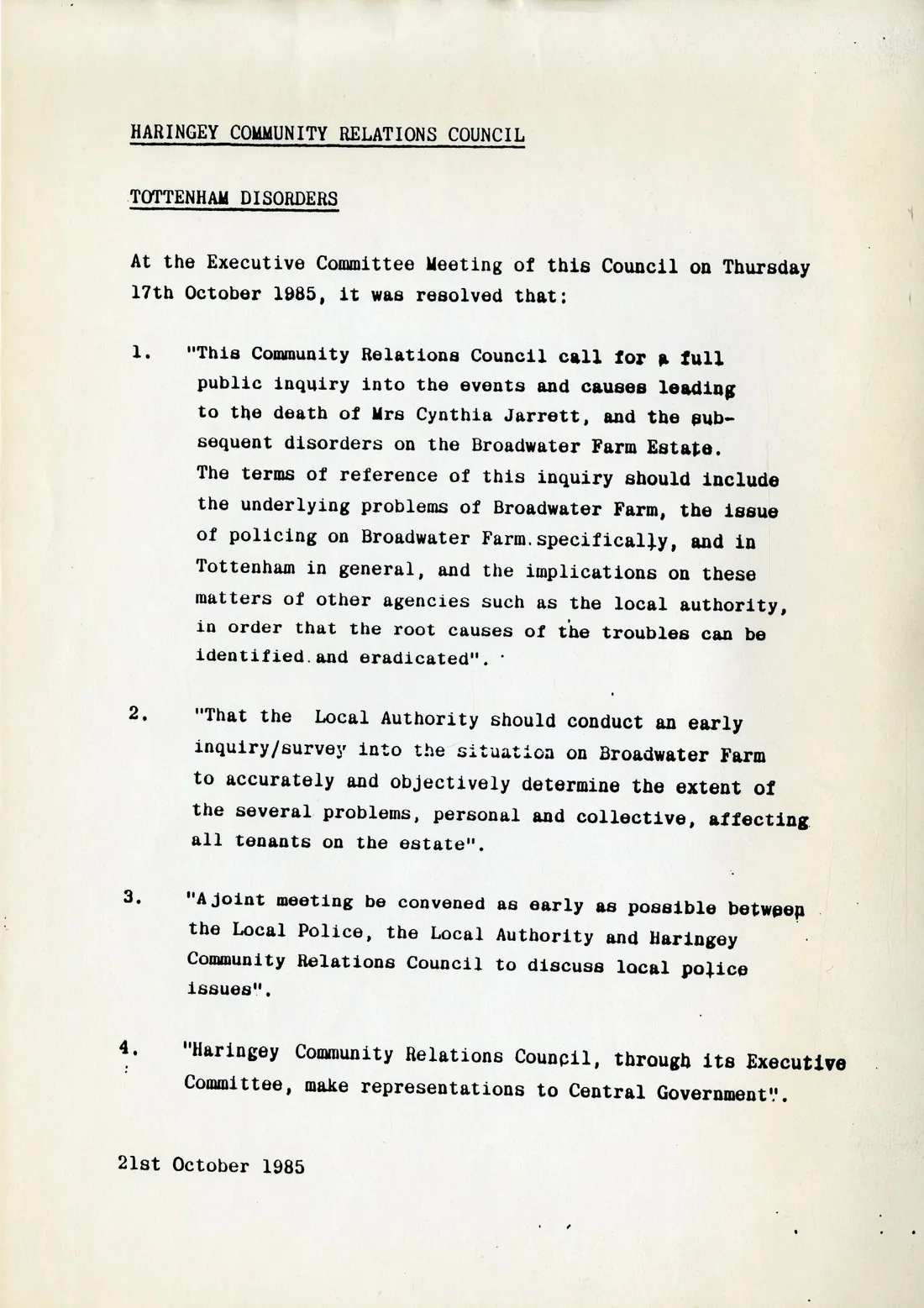
What these council and community bodies argued, is that the issue was not simply identifying or analysing the deep-rooted problems facing inner city communities, but correcting the failures by the government, implementing positive changes to address them, and immediately ending all actions by the police that only exacerbated the broken relationship with the local community. The Home Secretary initially refused calls for a public inquiry, on the basis that the Scarman Report, which was published as a result of the 1981 Brixton riots, had already outlined the root causes of such ‘disorders’.
