
Back to Challenging oppressive policing
Broadwater Farm Inquiry
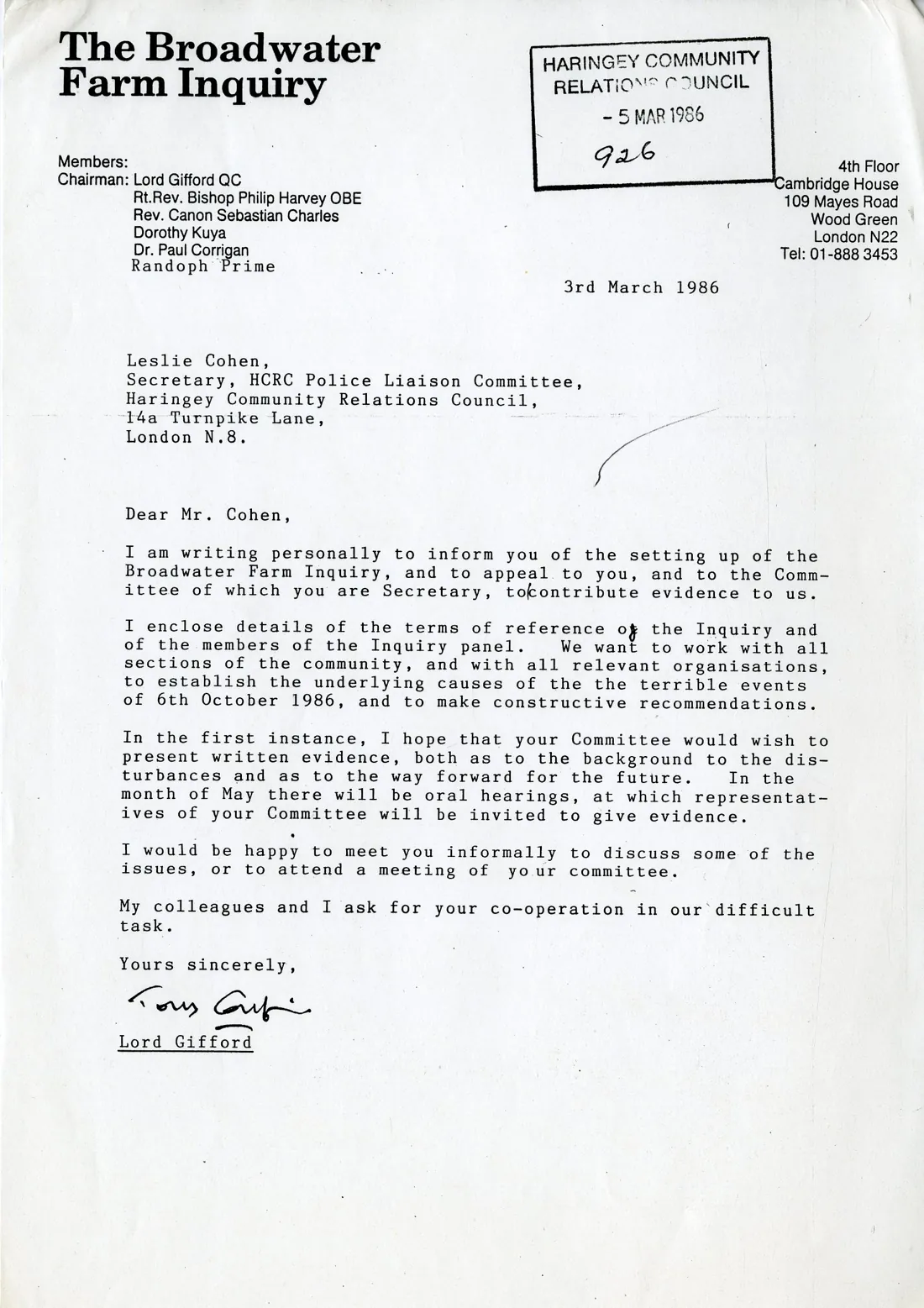
After repeated calls for an independent inquiry were denied, Grant set up one funded by the Council itself. The Broadwater Farm Inquiry was set up in March 1986, chaired by the then Lord Gifford QC. Members of the Inquiry team included Rev. Bishop Philip Harvey, Rev. Canon Sebastion Charles, Dorothy Kuya, Paul Corrigan, and Randolph Prime. These individuals were selected by the council due to their understanding of the societal issues that the uprising highlighted. The objective of the inquiry was laid out as follows:
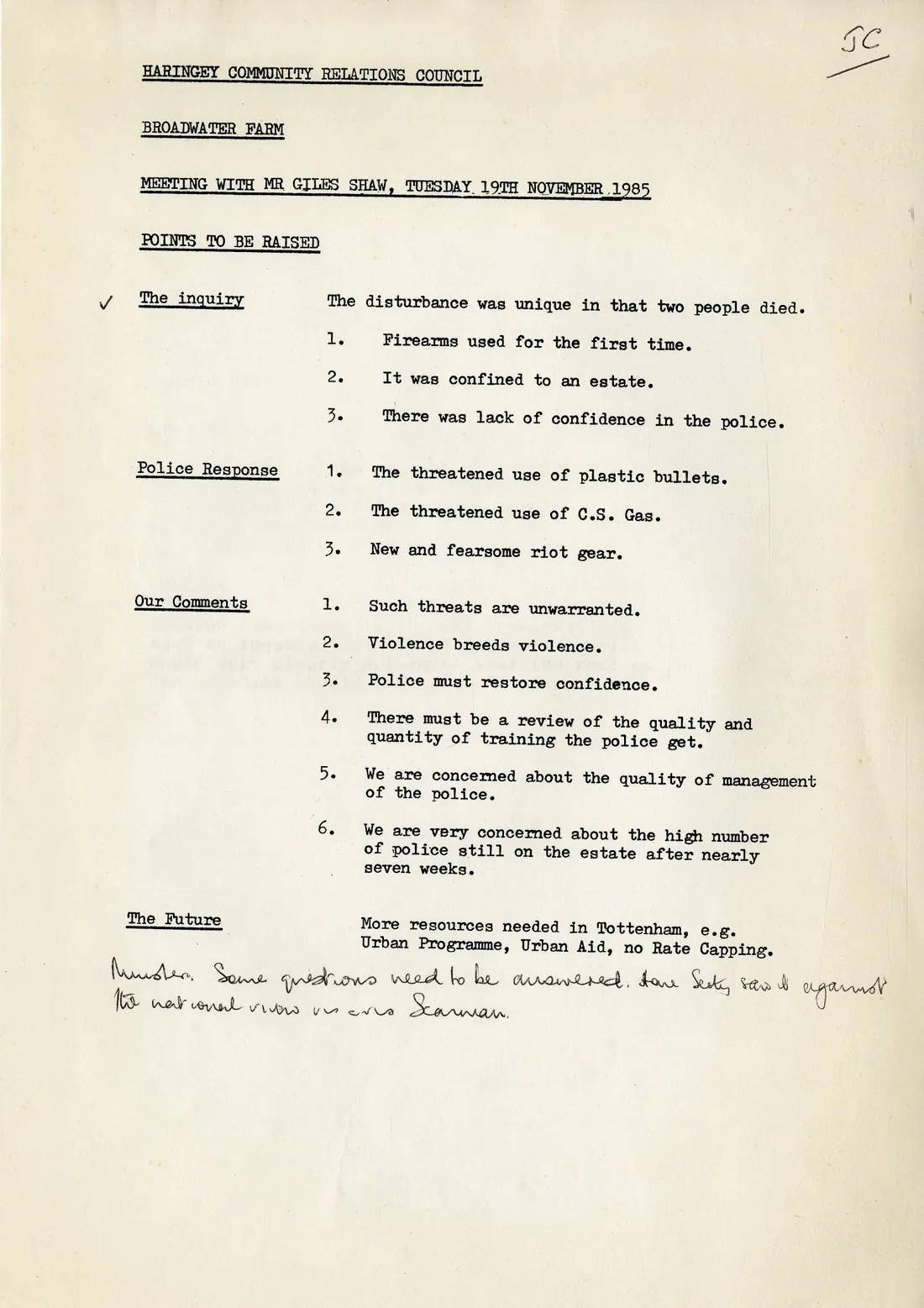
“To inquire into and report on the disturbances on Broadwater Farm… and in particular to consider:
Social and economic conditions within the London Borough of Haringey;
The policing of the area before and after the disturbances
The racial and other aspects of the relationship between the police and residents of the area
The role of the relevant statutory and voluntary agencies concerned with policing and community relations.
And to make recommendations”
As chair, Lord Gifford requested evidence from various relevant bodies, including the Police Liaison Committee, Haringey Council, and members of the local community. However, due to the Home Secretary’s aforementioned reluctance for such an inquiry, the delay in eventually setting it up had an impact on its findings, as the report stated: “by the time we began our work, memories had faded and some of the impact which the Inquiry could have had was lost”. There was also a climate of fear that existed within the local community, due to the lack of trust felt toward the police after the immense number of arrests made in conjunction with the riots. Although the inquiry involved a confidential process, many people felt they couldn’t contribute their perspectives without consequence. Alongside this, the Police Commissioner also refused to provide evidence to the inquiry, severely limiting the available material that the team could glean from. The media coverage of the uprisings proved an invaluable resource for exposing how racism manifested in British society. As part of the Inquiry process, Dorothy Kuya famously drew up an analysis entitled ‘The Broadwater Farm Disturbances and the Press’ , which, through diligent studies of various different newspapers, outlined how racism had skewed the events and fuelled the racist stereotypes suffered by young Black people, and indeed Bernie Grant: “He is now ‘Barmy Bernie who must be disowned’… The new bogeys are the English born Black Youth… They have been characterised as ‘muggers’, ‘rapists’ ‘lazy’ ‘drug pedlars’ and ‘drug takers’ and worst of all ‘murderers’”.
In 1987, Judge Margaret Burnham and Professor Lennox Hinds, both seasoned US legal professionals, published the ‘Burnham Report of International Jurists in Respect to Broadwater Farm Trials’, the report proved a damning assessment of oppressive arrest and detainment procedures, and exposed the various levels of failure and human rights abuses present in the investigation into the murder of PC Keith Blakelock.
