
Back to Challenging oppressive policing
Roger Sylvester, Ibrahima Sey and Black deaths in custody
BG_P_14_3_100 MPs call for police videos
This document from the Bernie Grant Archive highlights Bernie Grant's pioneering role as one of the first black MPs in modern Britain, his leadership in anti-racist campaigns, and his advocacy for racial justice both domestically and internationally. It is useful for understanding Grant's commitment to fighting institutional racism, his political activism, and the impact of his work on promoting equality and community empowerment.
On the 11 th January 1999, Roger Sylvester, a Black Tottenham resident who suffered from bipolar disorder, was detained by police outside his home during a mental health crisis. After being taken to St Anne’s Hospital in Haringey, he was restrained by 6 police officers during a medical assessment. He fell into a coma as a result, and died 8 days later on 19 th January. As a press statement by Haringey Race Equality Council detailed, Sylvester’s death was part of a pattern of deaths of black people after police contact, and was connected to the deaths of Cynthia Jarrett, Joy Gardner, and at a broader level the murder of Stephen Lawrence. His family and local community soon organised the Roger Sylvester Justice Campaign, demanding the suspension and prosecution of the officers involved in his death, a public inquiry, and legal aid. As his local MP Bernie Grant was active in the struggle for justice. Paul Boateng, who was first elected to Parliament in 1987 alongside Grant as one of the three first Black MPs, also voiced his support for justice. From the outset of the investigation into Sylvester’s death, his family members, Grant and others raised concerns about the way it was conducted. These concerns included information leaks from the police to the press, and details of the post-mortem were being shared before it had even been completed. Pathologist Freddy Patel was later reprimanded by the General Medical Council after it was revealed he’d released medical details about Sylvester to the press. An inquest in 2003 found that Sylvester had died from serious brain damage and cardiac arrest as a result of being restrained. Despite passing a verdict of unlawful killing, the officers involved successfully overturned it in 2004.
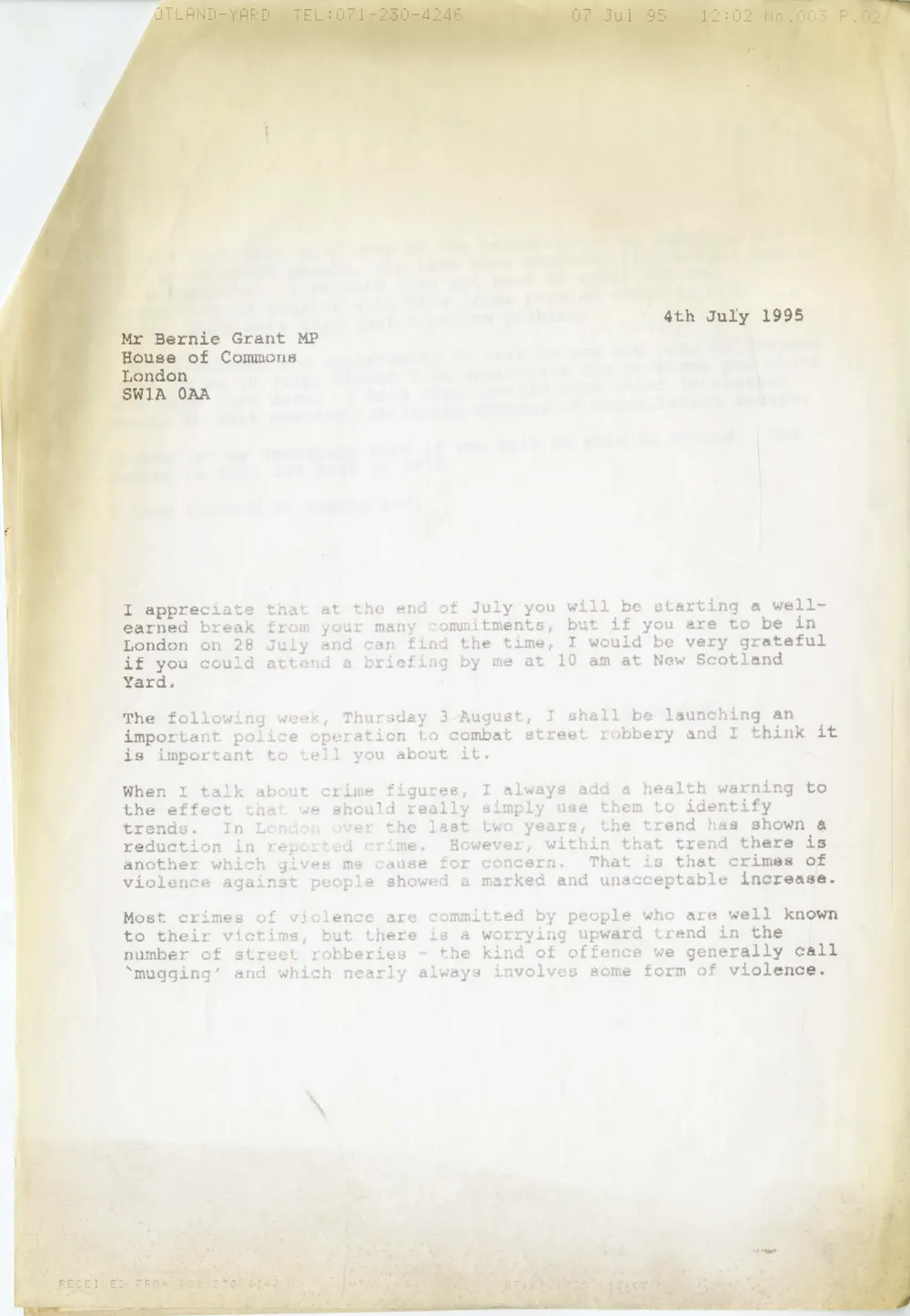
BG_P_4_7_3 Grant letter to Paul Boateng
This document is a letter from Bernie Grant MP discussing the rise in violent street crime, particularly among young black people, and inviting Paul Boateng and others to a police briefing on a new operation to combat street robbery. It is useful for understanding Bernie Grant’s engagement with crime and community issues, highlighting his role in addressing sensitive social problems affecting his constituency and broader themes of race, policing, and youth exclusion.
On 16th March 1996, Ibrahima Sey, 29-year old Gambian asylum seeker and father of two, died in police custody. He had been arrested after a domestic dispute in his home, and taken to Forest Gate police station, where he was restrained and put in handcuffs. His friend who accompanied him to the station recalled that: “When we arrived at the police station we were talking peacefully when police grabbed him by his neck and legs and turned him on his stomach. Three times he said to me, ‘Do you see what they are doing to me?’”. In the aftermath of his death, and before these details had been revealed by an inquest, Bernie Grant called for video cameras to be installed in police vans, yards, cells and charge rooms, stating: “had there been video cameras in the police van and yard, we might have had a chance of finding out what happened to Mr Sey”. Grant also called for the suspension of the officers involved, a demand that was shared with the family who launched a justice campaign. An inquest into his death a year later confirmed that he had been sprayed with CS gas while handcuffed on his knees and surrounded by over 12 police officers. After being sprayed, he was then restrained face down on the floor for over 15 minutes before he stopped breathing. The jury at this inquest delivered a verdict of unlawful killing.
