
Back to Challenging oppressive policing
Stop and search and racist profiling
From the 1970s onwards, what was commonly referred to as the ‘sus’ law, which was based on Section 4 of the Vagrancy Act 1824 , permitted police officers to stop, search and arrest individuals they deemed ‘suspicious persons’. This police power was quickly abused to target young Black people at extremely disproportionate rates. After the Brixton Uprising in 1981, and similar uprisings around the country that same year, the Scarman Report concluded that these unrests were largely due to anger and resentment at the use of the ‘sus’ law. The Scarman Report recommended that it be replaced with new stop and search legislation. This was introduced in 1984 with the Police and Criminal Evidence Act (PACE), which repealed the former ‘sus’ laws and introduced the power to stop and search people with “reasonable grounds”. Despite this reform in the law, the abuse of stop and search as a police power continued and still affected young Black people at disproportionate rates. The borough of Haringey, and Tottenham in particular, was a hotbed for this form of police harassment. Throughout his political career, Bernie Grant took up this issue of stop and search, and pressed the Metropolitan Police and British government for transparency, accountability, and reform of these practices, and was able for the first time to elicit hard evidence for what the black community already knew about the discriminatory use of stop and search powers.
For example, in the year 1994, Grant noticed a stark increase in the number of people in his constituency who were being stopped and searched, and noted that the majority of them appeared to be Black motorists. Upon pressing the Superintendent of Tottenham Police Station for figures in July 1994, the data he later received demonstrated that instances of stop and searches had indeed increased since 1993, by a staggering 100% . The data also showed that around 90% of those stop and searches conducted led to no follow up arrest, meaning that 90% of these stops were conducted without justification. Grant wrote to the Haringey Race and Equality Council, Haringey Community and Police Consultative Group, and the incoming Chief Superintendent of Tottenham Police Station David Gilbertson, in November 1994. Gilbertson’s response to Grant indicated that Grant’s requests for proper investigation were taken up by the Community and Police Consultative Group, and that Grant and Gilbertson would maintain communication about the issue, and a positive relationship.
Grant therefore used his position to demand the first ever figures denoting the break down of stop and search incidents by ethnicity. The figures confirmed what members of the black community had always known, but to that point could not evidence effectively.
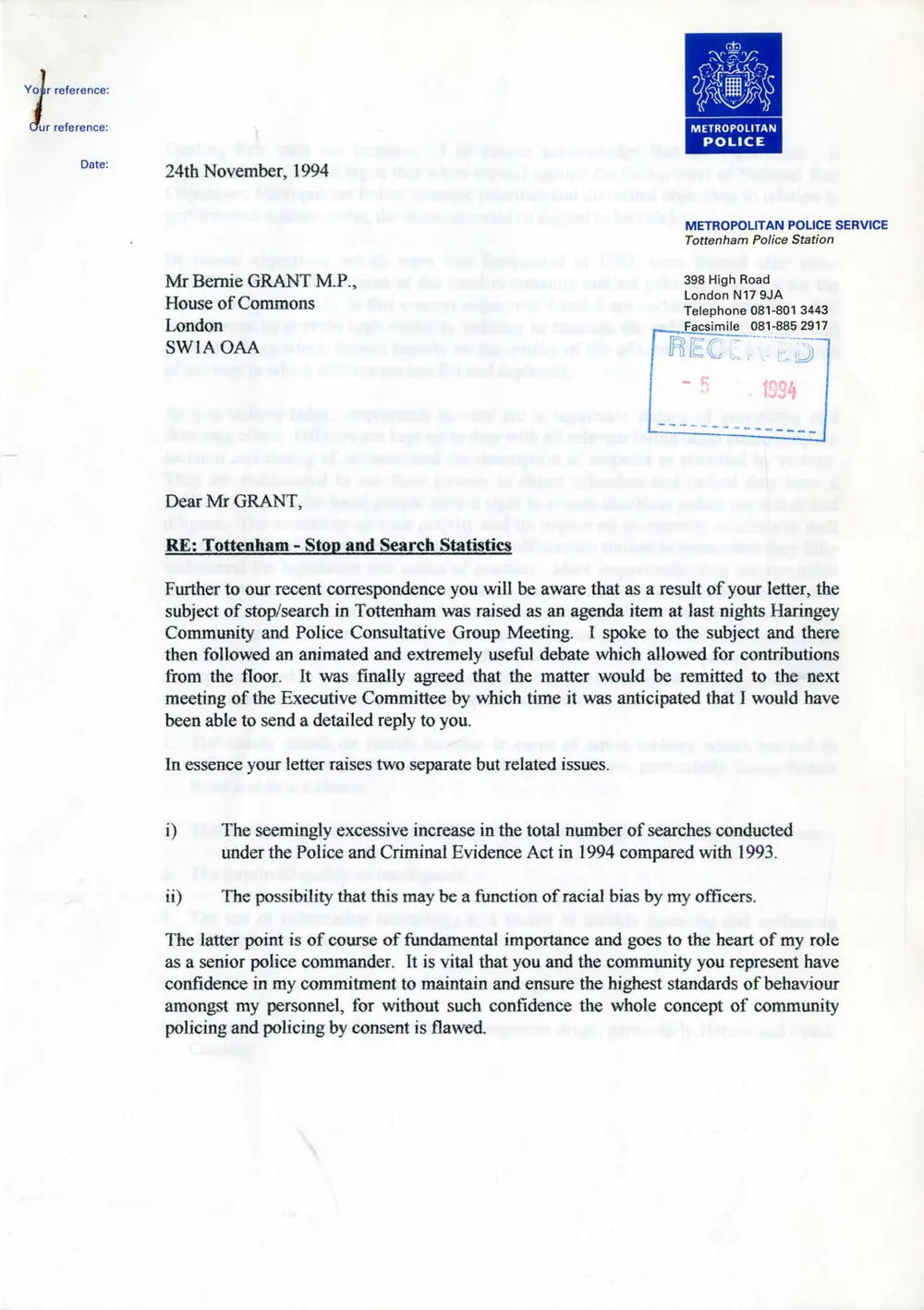
Bg_P_18_1_147 David Gilbertson letter on stop and search rates 1994
This 1994 letter from Chief Superintendent David Gilbertson responds to concerns about stop and search rates in Tottenham, explaining the reasons for increases, the monitoring of ethnicity in stop and searches, and the importance of maintaining community trust through proper use of police powers. It is useful for understanding the policing context and challenges faced during Bernie Grant’s time, illustrating official responses to racial sensitivity and community relations amid crime and stop/search controversies linked to his campaign themes.
On 2nd December 1994, Grant raised the increase of stop and searches during a parliamentary debate on policing, noting that between 1990-1993, instances of stop and searches had on the whole increased by 50% despite a fall in the number of arrests made from these stops. Jeremy Corbyn made an additional point during the debate, that many people from Black and minority ethnic backgrounds who are stopped, often face passport and immigration checks during these stops, which can detain them for several hours. Grant requested a breakdown of the stop and search data across London boroughs which included the ethnic background of those stopped, as well as information related to his own constituency. The statistics not only displayed the shocking ethnic disparities between those stopped and searched in London boroughs, they also detailed the terminologies used to describe different ethnic backgrounds. ‘Negroid Types’ was used to refer to people assumed to be of African descent, ‘Indian and Pakistani types’ were used to refer to people assumed to be of South Asian descent, etc.
These facts were shared by Grant, with fellow Labour Party MPs and the Haringey Racial Equality Council, the chairman of which shared Grant’s outrage at the “offensive” terminologies used. These terms had also been used by police during the days of the ‘sus’ law, and certainly in 1981 during the series of uprisings. Clearly very little had changed in between then and the mid-90s. Alongside pressing the Metropolitan Police, Grant and Gilbertson worked on a stop and search leaflet to be distributed to the Haringey community which provided information on people’s rights during a stop and search. This initiative which was supported by Haringey Council, Haringey Racial Equality Council, the Asian Centre and the Asian Action Group, although there was some criticism about the lack of consultation during the process.
When Gilbertson was promoted out of his role as Chief Superintendent of Tottenham, he wrote to Grant that “in all my dealings with you insincerity is not a charge that could be laid at your door”. Grant’s response portrayed this mutual feeling, and also reveals that Gilbertson’s approach toward the job of policing in Tottenham was unfortunately rare: “Sadly there have been few of your predecessors who have been prepared or able to match your creativity and integrity”. Not all conversations with senior members of the police were so fruitful. Grant initially raised the issue of stop and search with Commissioner of the Metropolitan Police Paul Condon on 9th December 1994, after addressing having raised it in parliament. Once armed with the data on stops and searches which showed that in some boroughs, Black people accounted for 57% of all stops, Grant publicly challenged Condon to provide an explanation in February 1995. However, Condon seemingly believed the excessive and discriminatory use of stop and search was justified, and stated in a letter to Grant in July 1995 that: “It is a fact that very many of the perpetrators of muggings are very young black people, who have been excluded from school and/or unemployed”. Stop and search and PACE still remains a pillar of police practices today. And thus, the problems it poses in regards to racist discrimination and criminalisation of Black and global majority people remains a key issue. Many activists, organisations and public officials continue to challenge this police power, and its overuse on Black and global majority people.
During a parliamentary debate on PACE in December 2010 , Richard Fuller, then Conservative MP for Bedford, pointed to the fact that Black individuals were six times more likely to be stopped and searched than their white counterparts, and Asian individuals were twice as likely. He acknowledged that this subject was a rare occurrence in which he agreed with the stance of Bernie Grant, even quoting his words from 1997: “Nothing has been more damaging to the relationship between the police and the black community than the ill judged use of stop and search powers. For young black men in particular, the humiliating experience of being repeatedly stopped and searched is a fact of life”. Decades on from this statement, discriminatory policing continues to be a significant issue for Black people in Britain. Recent statistics demonstrate that Black people are 7 times more likely to be stopped and searched than their white counterparts, although this rate is likely to be higher considering the number of stop and search reports that have reported a person’s ethnicity as “unknown”. Further to this, Black people continue to be disproportionately subjected to force during instances with police, and are more likely to die in police custody or after contact with police than their white counterparts. Bernie Grant’s emphasis on the importance of this issue remains highly relevant.
BG_P_18_1_96
This document contains papers presented at the 1990 World Conference on Reparations to Africa and Africans in the Diaspora in Lagos, Nigeria, discussing the legal basis and global precedents for reparations claims related to slavery and colonial exploitation. It is useful for understanding Bernie Grant’s campaign and broader reparations debates by providing context on historical claims, justice-based arguments, and international examples supporting demands for acknowledgement, apology, and compensation.
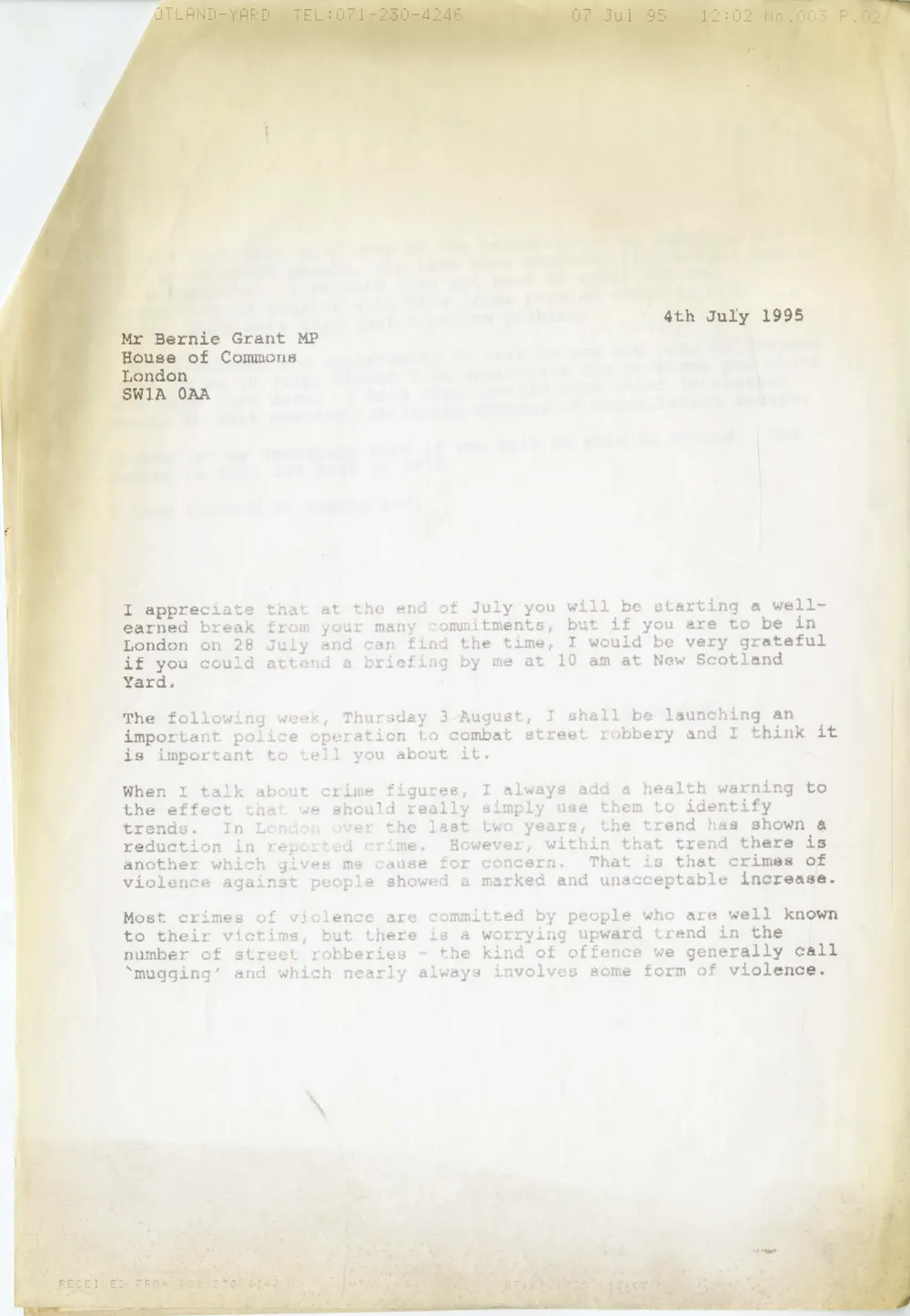
BG_P_18_1 Paul Condon letter
This document is a letter from Paul Condon of New Scotland Yard to MP Bernie Grant, dated July 1995, discussing an invitation to a briefing on a police operation targeting street robbery and the complexities of addressing youth crime among black communities. It is useful for understanding Bernie Grant’s engagement with law enforcement and community issues, highlighting his involvement in crime prevention discussions affecting his constituency and the broader themes of race, social justice, and crime.
