
Back to Internationalism and Anti-Imperialism
South Africa
D uring South Africa’s brutal Apartheid regime, Grant was forthright in condemning the historic racist ideology underpinning Apartheid. After the successful struggle for majority African rule he then supported the transition to a post Apartheid society. He worked alongside many other prominent figures in the global Anti-Apartheid movement, including US Civil Rights icon and former congressman Reverend Jesse Jackson, members of the African National Congress (ANC), Labour Party’s Black Sections and the highly influential Anti-Apartheid Movement in the UK. Indeed, as one of the nation’s most respected spokespersons for Britain’s Black communities, Grant was a major advocate for solidarity movement with one of the century’s most long running and significant Black freedom struggles. In his capacity as Member of Parliament, he criticised the government’s failures to support Nelson Mandela during his imprisonment, and indeed Britain’s collusion with the leaders of the Apartheid regime. Grant frequently publicised the plight of South Africa and its people in the House of Commons and within the community.
![Preview of Haringey Council Does Not Buy South African Goods [BG_P_5_1]](/bg-data/processed/webp/medium/INTERNATIONALISM__Haringey_Council_Does_Not_Buy_South_African_Goods_page_2_medium.webp)
Haringey Council Does Not Buy South African Goods [BG_P_5_1]
This document is a 1984 campaign statement and press release from Haringey Council and local groups opposing apartheid by refusing to buy or support South African goods and organizations linked to the apartheid regime. It is useful for understanding Bernie Grant’s activism and the local anti-apartheid campaign by showing the Council’s official boycott policies and the opposition they faced, notably from the Haringey National Front.
This was just one respect in which Grant used his position to pursue the struggle against apartheid. As leader of Haringey Council, he had ensured disinvestment from Apartheid linked enterprises and promoted the cause alongside the Haringey Anti-apartheid campaign which included several notable exiled activists, such as Oliver Tambo. Haringey Council resolved in 1984 “to campaign to end all links between the Council and the Apartheid regime of South Africa”. Once in Parliament he was asked to become a member of the Executive Committee of the ANC and attended its International Conference in Tanzania in 1988. However. Prime Minister Margaret Thatcher viewed Nelson Mandela as a “terrorist” and supported the Apartheid regime in South Africa, due in large part to Britain’s significant financial investment in the South African economy. At this time, British firms made up 50% of foreign investment in South Africa, and had been the country’s biggest foreign investor between the 1950s-1960s. These were the challenges that Grant and the Anti-Apartheid Movement in Britain struggled against. Despite great financial investment by British firms, an overwhelming amount of the British public, as well as many organisations and businesses, stood against Apartheid and boycotted South African goods. For instance, in July 1986, it was estimated around 27% of British people boycotted South African products. As an elected official, Grant held businesses to account to uphold the boycott movement.
![Preview of Letter to Tesco Store regarding selling of South African goods [BG_P_18_2_38]](/bg-data/processed/webp/medium/INTERNATIONALISM__Letter_to_Tesco_Store_regarding_selling_of_South_African_goods_page_2_medium.webp)
Letter to Tesco Store regarding selling of South African goods [BG_P_18_2_38]
This 1987 letter from Bernie Grant, MP for Tottenham, to Tesco criticizes the store’s policy of selling South African goods, urging it to stop supporting apartheid by removing these products. The document highlights Grant’s commitment to racial justice and community values, offering insight into his activism against apartheid and the broader campaign for equality during that period.
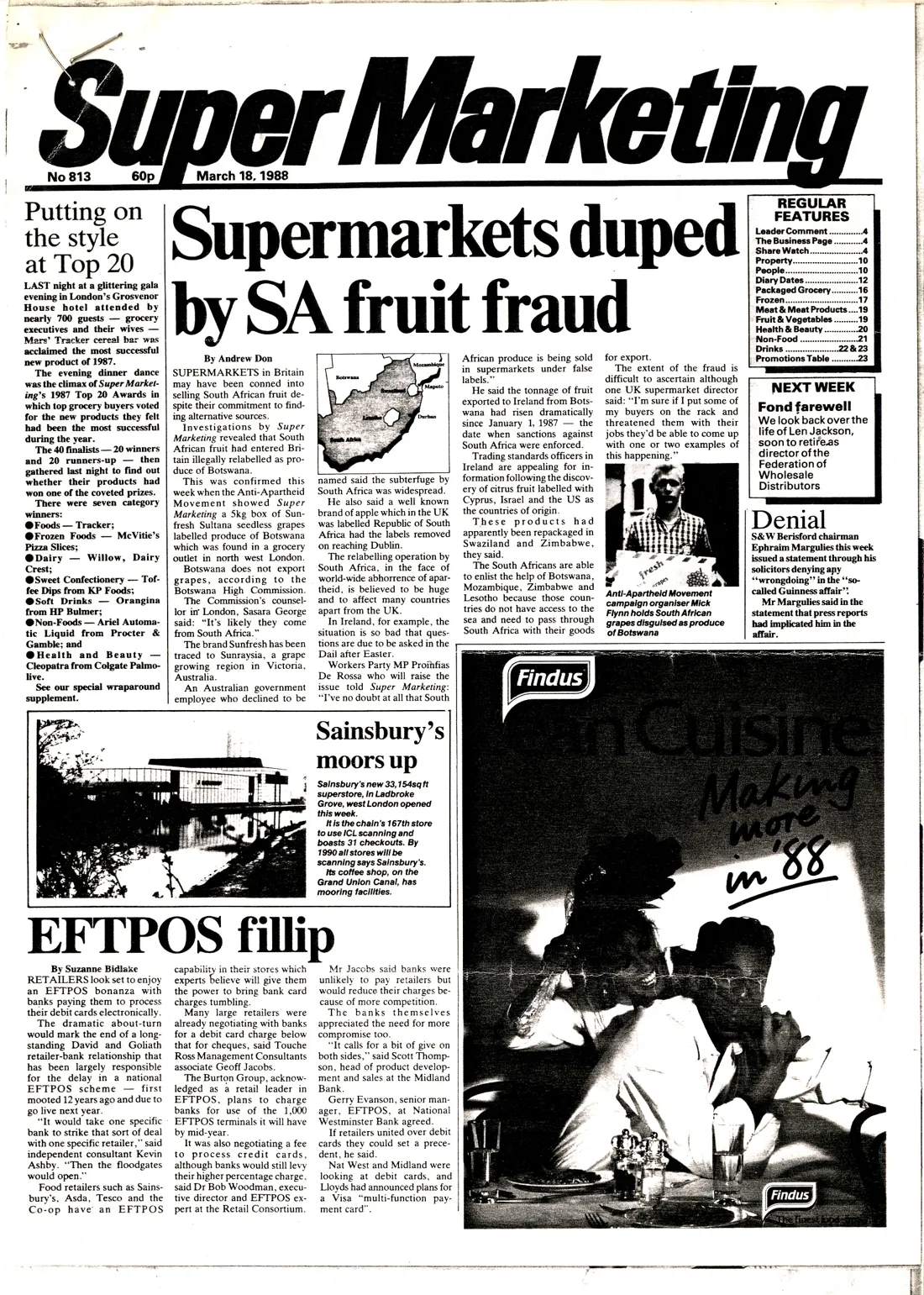
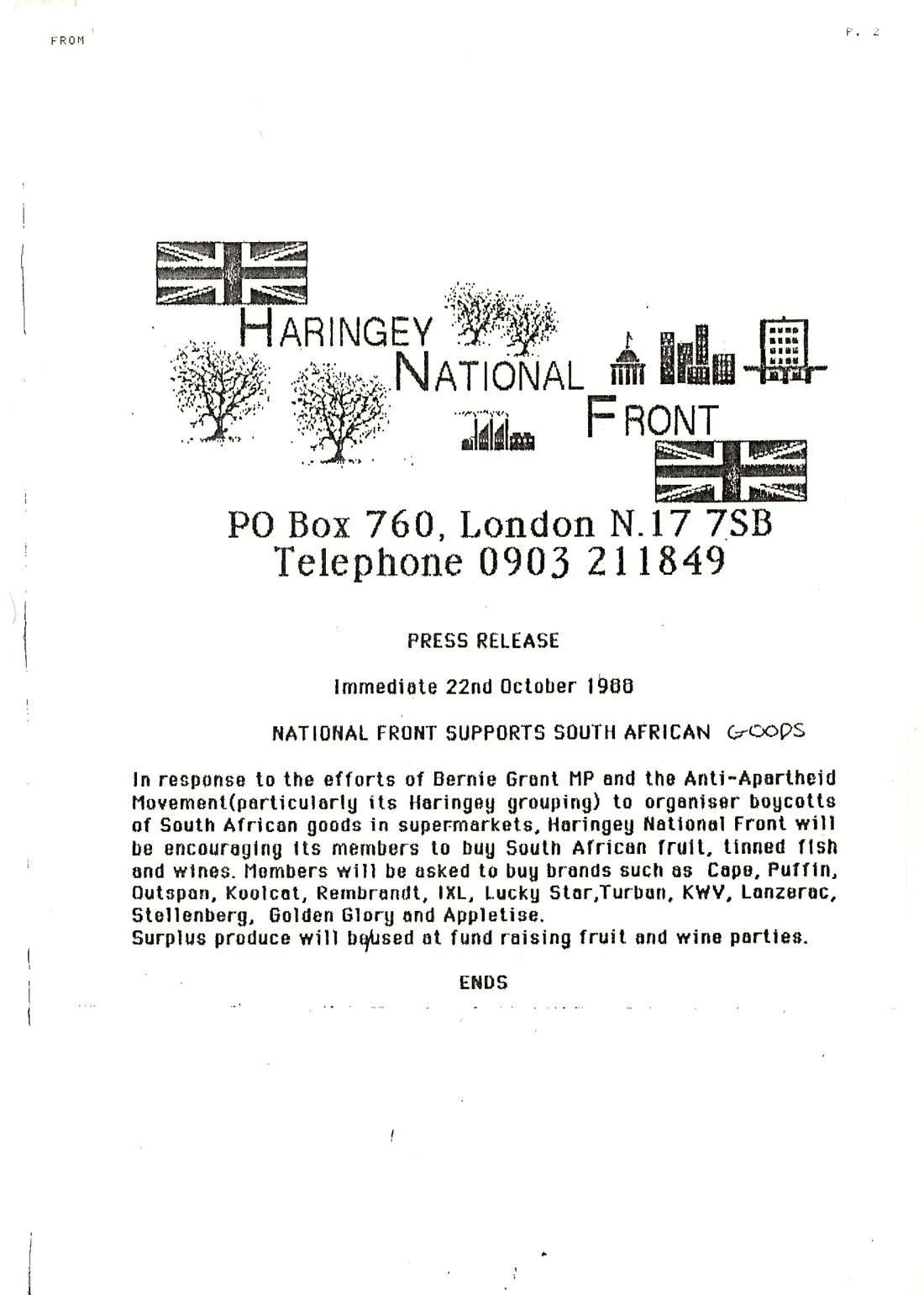
In September 1987, Grant wrote to the manager of Tesco’s Tottenham store, to “express my profound refusal” at the store’s stocking of goods originating from South Africa, and wrote that his disapproval was also shared by a large majority of the Tottenham community. Over the course of Spring and Summer of 1988, the SuperMarketing newspaper led an exposé of a scandal wherein stores were duped into buying goods which displayed false country of origin stickers to mask their South African origins. The newspaper reported Grant as leading the charge against Apartheid South Africa in the House of Commons. SuperMarketing quoted Grant as saying “We need a few MPs to work on something as big as this”. Indeed, while Grant often led racial and social justice campaigns in the House of Commons, a large part of his energies were directed at mobilising other MPs to follow suit in support. While much of the British public and businesses were opposed to Apartheid and committed to the boycott, the far right movements proudly boasted of their ongoing support for Apartheid South Africa, as evidenced by the National Front’s public declaration that it was encouraging its members to buy “South African fruit, tinned fish and wines” as a direct response to Grant’s efforts.
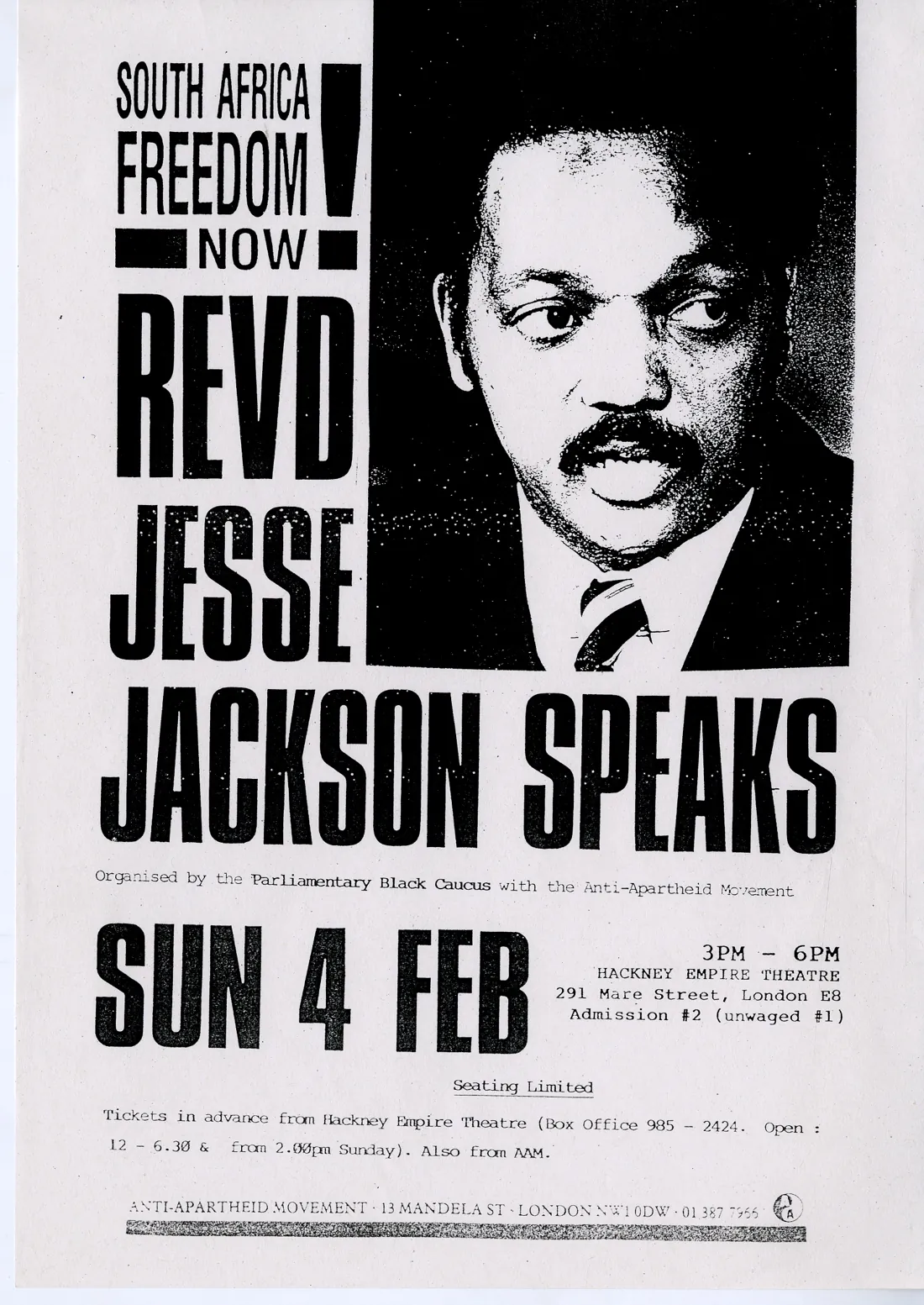
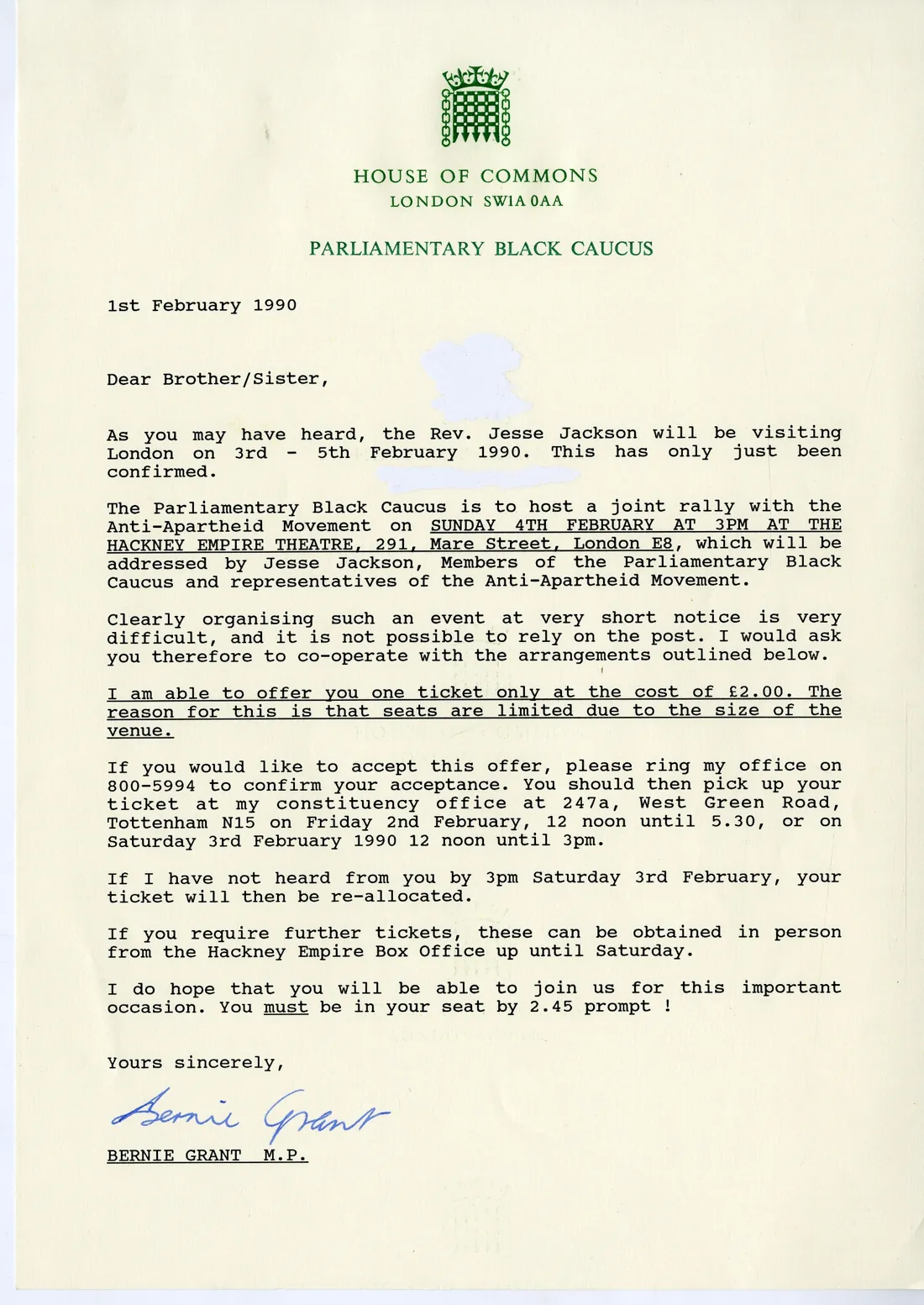
In early February 1990, the under the auspices of the Parliamentary Black Caucus, he organised for Jesse Jackson to speak at a mass rally at Hackney Empire Theatre, in collaboration with the Anti-Apartheid Movement. In January 1990, as rumours of Mandela’s release began to emerge, Grant joined the delegation of Rev Jesse Jackson to South Africa and was thus present on the day Nelson Mandela release. On 11th February 1990, Nelson Mandela was finally released from prison after serving 27 years behind bars. On his return, he gave a number of speeches which reported on what he saw, and what South Africans had told him about the situation there.
As he outlined to a crowd at the Selby Centre in Haringey, the situation in Soweto was “at boiling point” and the South African police force were “part and parcel” of the right wing elements in the country. His speech was also full of lighthearted anecdotes that portrayed the great sacrifices made by South African Anti-Apartheid activists, such as the remark that serving prison sentences were viewed as a badge of honour. In the House of Commons he described the extreme police brutality made possible by the Apartheid regime’s declaration of a state of emergency, and urged Thatcher’s government to honour the economic sanctions placed on Apartheid South Africa by the international community, amidst its attempts to lift them. Grant’s speech was also significant for articulating the gravely complex task that lay before Mandela and other activists of the ANC as they entered into negotiations with the Apartheid government, after having been illegalised, imprisoned, or forced into exile. Grant was, in his own right, an Anti-Apartheid campaigner, and contributed this insight to British politics. In addition to his speeches, Grant also supported a number of Early Day Motions, including one on 12th February tabled by Conservative MP Robert Hughes, to commemorate Mandela’s release, support the intensification of the struggle against Apartheid, maintain sanctions, and for the British government to abandon attempts to lift the sanctions. The Motion received 144 signatures. On 13th February, Grant met with then-Prime Minister Margaret Thatcher, and suggested the government provide financial support for the emergence of democracy in South Africa.
On 3rd March, Grant received a letter from Thatcher which reacted positively to Grant’s suggestion. Mendi Msimang was a key figure in the ANC, and was its chief London representative , located at 28 Penton Street in Islington. In 1992, Grant reached out to Msimang to announce a new internationalist project – the Organisation of Africans in Europe. As described by Grant, this organisation was formed to provide mutual support and a voice for Africans in Europe. The vision for the organisation arose in the context of discussion about a ‘New World Order’ that was emerging in the context of the demise of the Soviet Union and the Eastern Bloc. In a letter to Msimang, Grant expressed plans for a mass rally in Britain, which would cover key international topics including the situation in Cuba, North Korea, Libya, Palestine, and other countries and regions that were affected by Western imperialism. The mass rally was also set to highlight the Black struggle against racism in Europe and the USA. Grant sought Msimang’s help to secure Mandela as one of the rally’s speakers. The Organisation for Africans in Europe would have no doubt been expansive and impactful, however after its founding, its objectives weren’t fully realised and it remained an incomplete project, which was overshadowed by Grant’s preoccupation with the Reparations movement. It did however, in its short lifespan, have close contact with the Organisation of African Unity, and correspondence with Zimbabwe, Libya and Ethiopia.
![Preview of Letter to Mendi Msimang, ANC [BG_P_2_41]](/bg-data/processed/webp/medium/INTERNATIONALISM__Letter_to_Mendi_Msimang%2C_ANC_12th_May_1992_medium.webp)
Letter to Mendi Msimang, ANC [BG_P_2_41]
This document is a 1992 letter from Bernie Grant MP to Mendi Msimang of the ANC, outlining plans to support African countries through a new European-based Organisation of Africans in Europe and proposing a solidarity rally in Britain featuring Nelson Mandela as a keynote speaker. It is useful for understanding Bernie Grant’s active role in international anti-apartheid and Pan-African campaigns, highlighting his efforts to galvanise black British support for the ANC and broader struggles in the Global South during the early 1990s.
Although the mass rally didn’t go ahead as planned, Mandela famously visited Britain on numerous occasions during the 1990s it was on the first of these occasion that Grant renewed his acquaintance with him, on several occasions, including on his visit to Haringey. In 1993, he paid a visit to the family of Stephen Lawrence after his racist murder. The visit highlighted the links between anti-racist causes here in Britain, and the struggles against colonial rule and racist systems globally. A year later, on 10th May 1994, Apartheid in South Africa came to an official end, and Mandela was inaugurated as the first Black head of state, and the first to be elected in a fully democratic election. As a longstanding supporter of the cause Grant was invited to the inauguration event in Pretoria , and continued his support for South Africa in its new chapter. Part of the challenge of newly democratic South Africa was to implement the many necessary political changes throughout the country, to promote racial equality after so many years of white minority rule and Apartheid restrictions. As part of this work, Haringey Council provided practical support as an example of a positive local government system. In 1996, Mandela again visited and addressed the Houses of Parliament, eluding to the issue of neo-colonialism, and therein the need for African Reparations , by reminding those in attendance that “the [African] continent bleeds still, struggling to service a foreign date it can neither afford or afford to repudiate”. As the chairman of the African Reparations Movement and figurehead of the British-based Reparations movement, Grant expressed his gratitude toward Mandela, noting that his speech “leaves us all Africans now”. In Grant’s view, Mandela’s speech left an indelible imprint on Britain and particularly Britain’s Black community, having raised two issues very close to Grant’s heart.
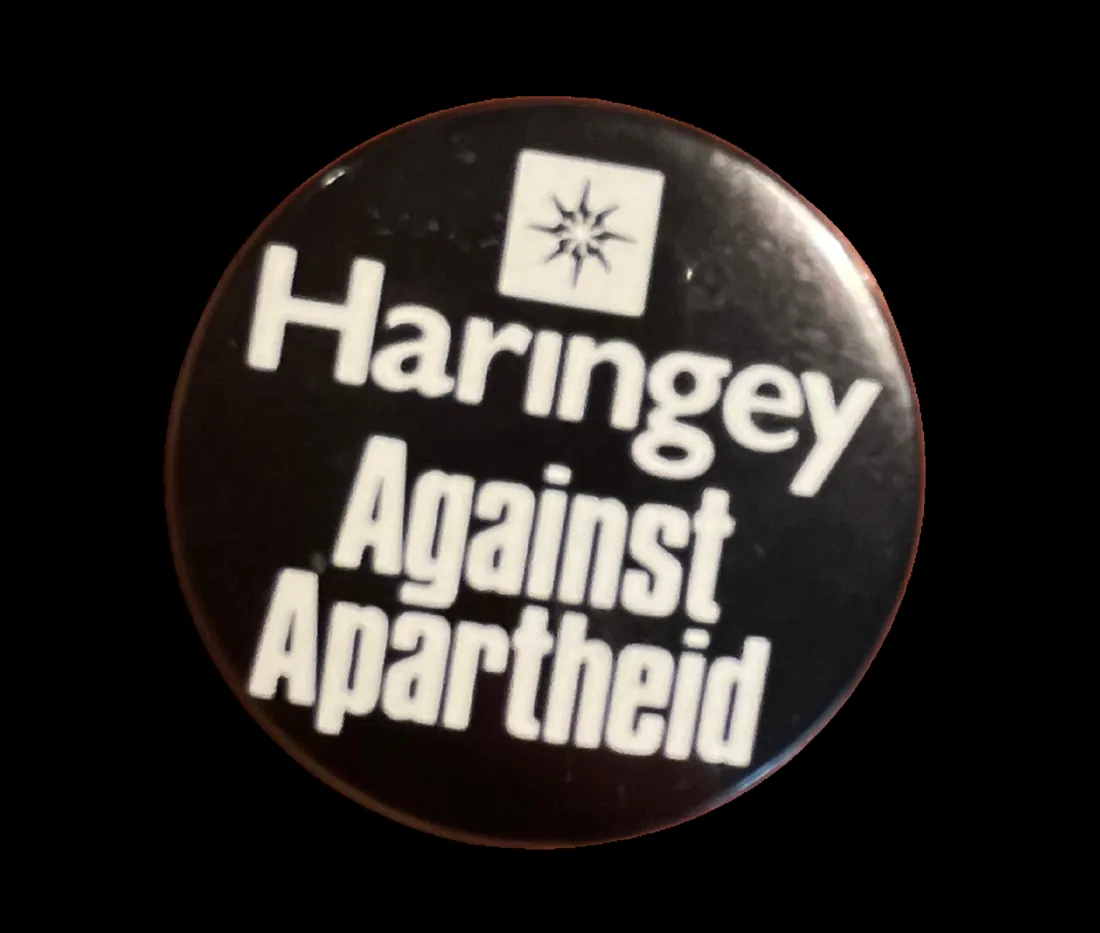
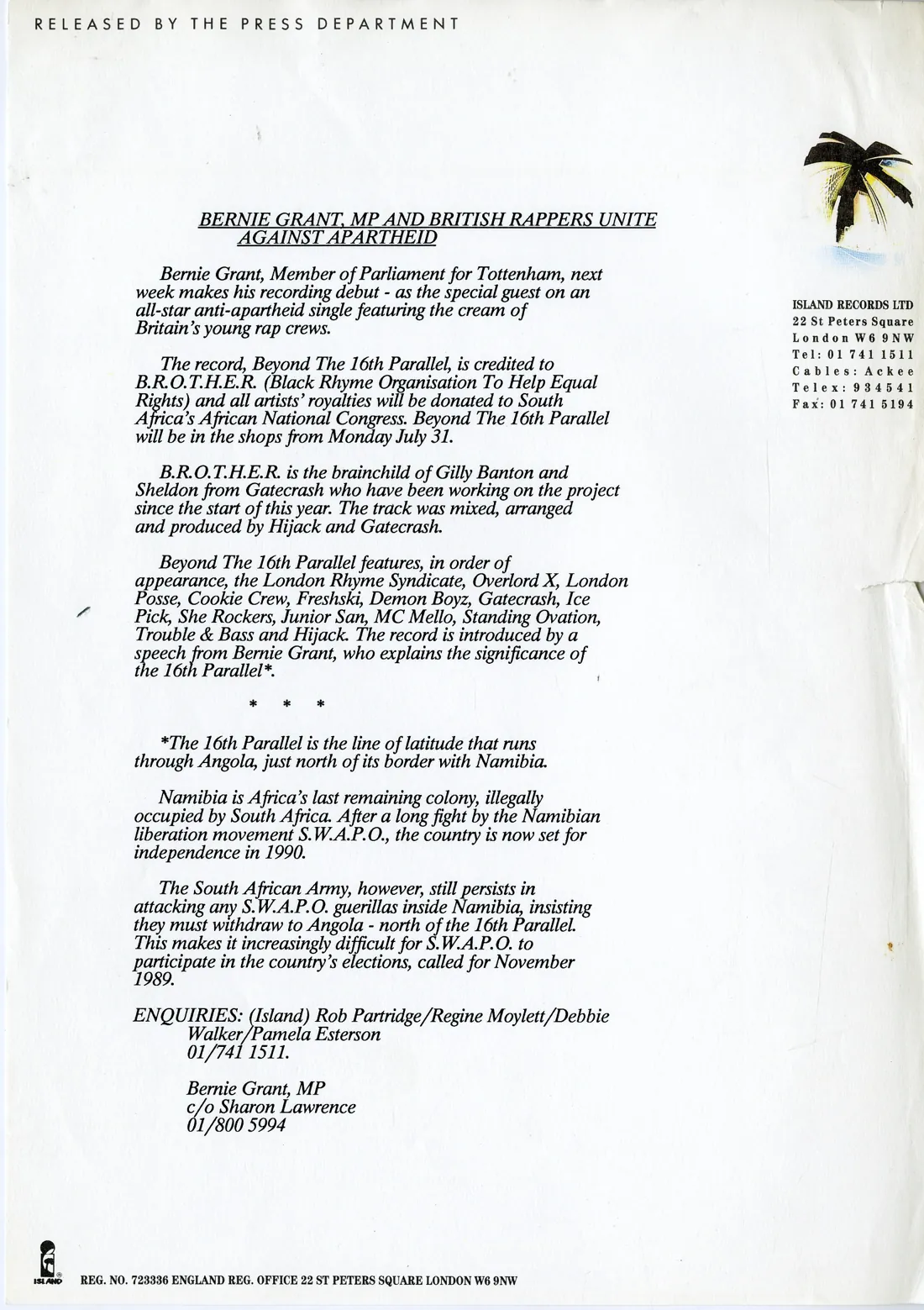
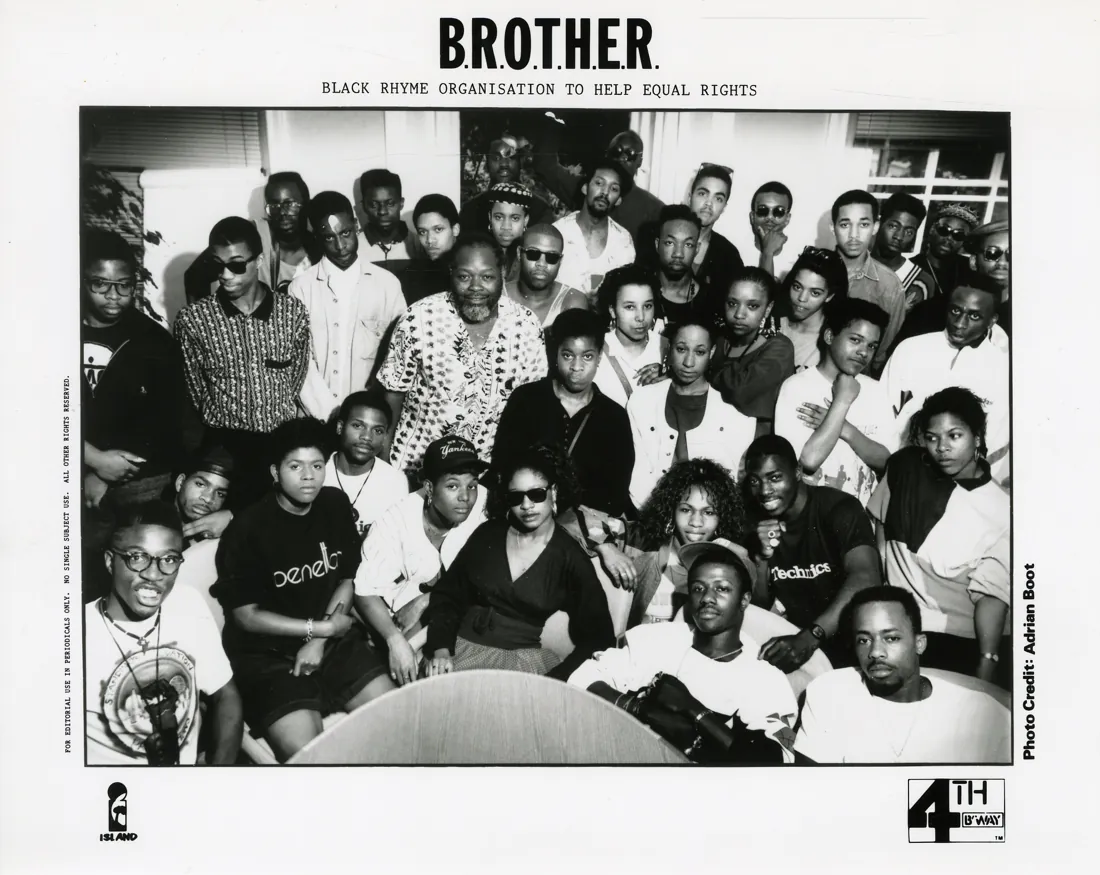
As he expressed in a press release in the aftermath of Mandela’s speech, it left two major tasks ahead for Britons: “This means two things. First of all we must ensure that young people, both Black and white, are taught about Africa and its history. Secondly, Black Britons must strengthen their links with Africa”. Much like other mass political movements, there exists a lot of memorabilia and ephemera from the Anti-Apartheid Movement and related campaigns, much of which is held at Bishopsgate. Grant possessed a few items which speak to his involvement in the movement, including badges, pins and mugs. These items provide insight into Grant’s role as an activist and campaigner, both within Parliament and as part and parcel of grassroots movements led by campaign groups and driven by people throughout Britain and across the world. In South Africa itself, Grant’s longstanding support of the development and education of the South African people amidst their struggle against Apartheid was well recognised. As a technology wizz himself, he aided the establishment of an IT training centre sponsored by Dell and Microsoft, and the building was subsequently named in his honour: The Communal Information Technology Centre: Bernie Grant Complex.
