
Back to Politics: Black Sections, the First Black MPs, and the Parliamentary Black Caucus
Black Sections
BG_P_11_5_2 Conference Draft
This document is a collection of papers presented at the 1990 World Conference on Reparations to Africa and Africans in the Diaspora, outlining legal, historical, and moral arguments for reparations related to slavery and colonial exploitation. It is valuable for understanding Bernie Grant's campaign context as it highlights the global reparations movement's foundations and the broader struggle for justice and recognition that influenced activists like Grant.
The Labour Party Black Sections was a product of efforts by Black and Asian members of the Labour Party, who argued for the need for better representation of Black and ethnic minority people in the party and British politics more broadly, and an end to the sidelining of issues which affected them. Prior to its establishment there were various Black and Asian local Labour Party groups who formed organically, but Black Sections provided a way of linking up and advancing these existent initiatives. In 1983, Black Sections was formed with its founding members including Bernie Grant, Diane Abbott, Paul Boateng, Marc Wadsworth (who became chair in 1985), and Sharon Atkin. It operated as a caucus open to African, Caribbean and Asian members, and other ethnic minorities in Britain. Not unusual for the time, it defined ‘Black’ as: “a political concept. It is used to include all racially oppressed minorities. Each geographical area, therefore, is likely to reflect its own ‘Black’ Communities”.
Bg_P_11_5_4 Black Sections frequently asked questions
The document "Bg_P_11_5_4 Black Sections frequently asked questions" outlines the purpose and nature of the Bernie Grant Archive, explaining its role as a public resource housing primary archival records related to Bernie Grant's life and work. It is useful for understanding Bernie Grant, the campaign, or related themes by providing direct access to original materials such as texts, photographs, and recordings, which offer firsthand insights beyond secondary interpretations.
Coordinated by its national committee, local Black Sections chapters quickly sprang up across the country, to represent the demands of local Black communities and Labour members. Within a year, there were 35 chapters throughout the UK. In a statement entitled ‘What We Stand For’, the Birmingham branch laid out the organisation’s broad aims: “First to get a better representation of Black people in the Labour Party and in British political institutions generally… The second reason for forming Black Sections is to pressurise for the Labour Party to adopt anti-racist policies and to make the Party campaign against racism”.
The ethos of Black Sections sought not only to mobilise Black individuals within party politics, but also in community organisations. In this way, it was more wide-ranging than a party-wide initiative, and was not necessarily preoccupied with bolstering Labour Party support, so much as providing a supportive and encouraging framework for Black-led political organising. The caucus also worked to influence the Trade Union movement, noting in 1986 that 3,000 Black workers had been involved in the Miner’s struggle of 1984-85. Insofar as representation in Trade Unions were concerned, despite a higher comparative proportion of Black workers who were Trade Union members than their white counterparts, only 4% of Black workers had been elected to Trade Union Posts, compared to 11% of white workers.
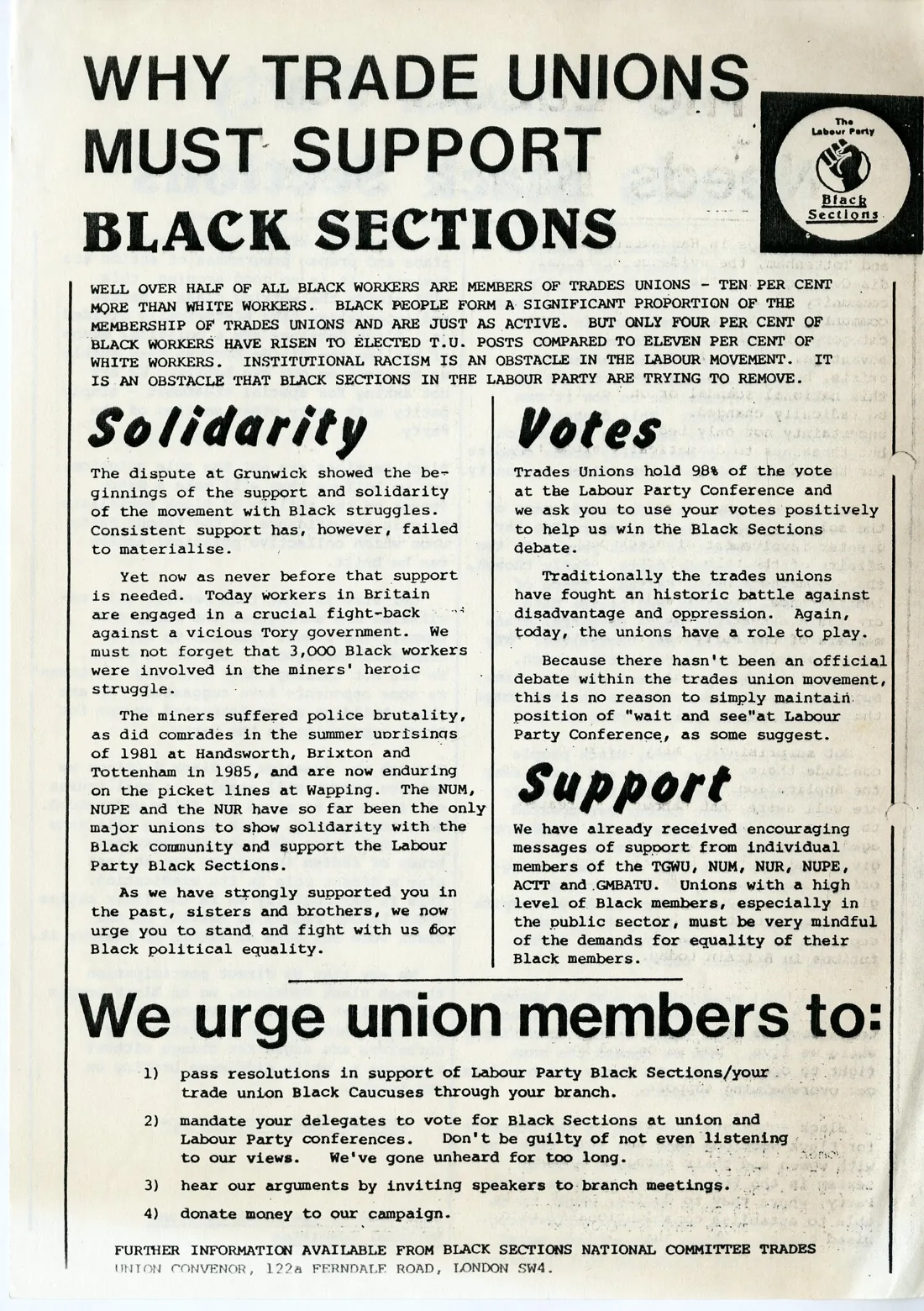
Black Sections argued that both the Trade Union movement and the Labour Party needed such a project, to continue to safeguard Black support electorally. Historically, Labour had positioned itself as the party representing the disadvantaged and poor of society. Black Sections highlighted that Black people, most often working class, were naturally aligned with Labour but remained neglected and ignored, although often giving Labour their vote. In 1983 for example, the same year as Black Sections’ founding, over 80% of Black and ethnic minority electors voted for Labour in the general election, many of which resided in inner city constituencies. But as Black Sections saw it, the lack of consensus on “the root causes of this national scandal” of racism, “not only bedevils the nation but threatens to erode support for the Labour Party in the Black community”. Black Sections accused the party of years of “indifference, neglect and racism”, which – in the context of the conditions giving rise to disturbances in Brixton, Bristol, Broadwater Farm, Birmingham, Liverpool, and elsewhere across England in 1981 and 1985 – pushed many Black people to conclude there was little point in voting for Labour, and indeed no point in voting at all. As Black Sections’ Marc Wadsworth later noted , these uprisings acted as a “wake up call to a society that was either indifferent or hostile to the demands of disenfranchised and disadvantaged Black people”.
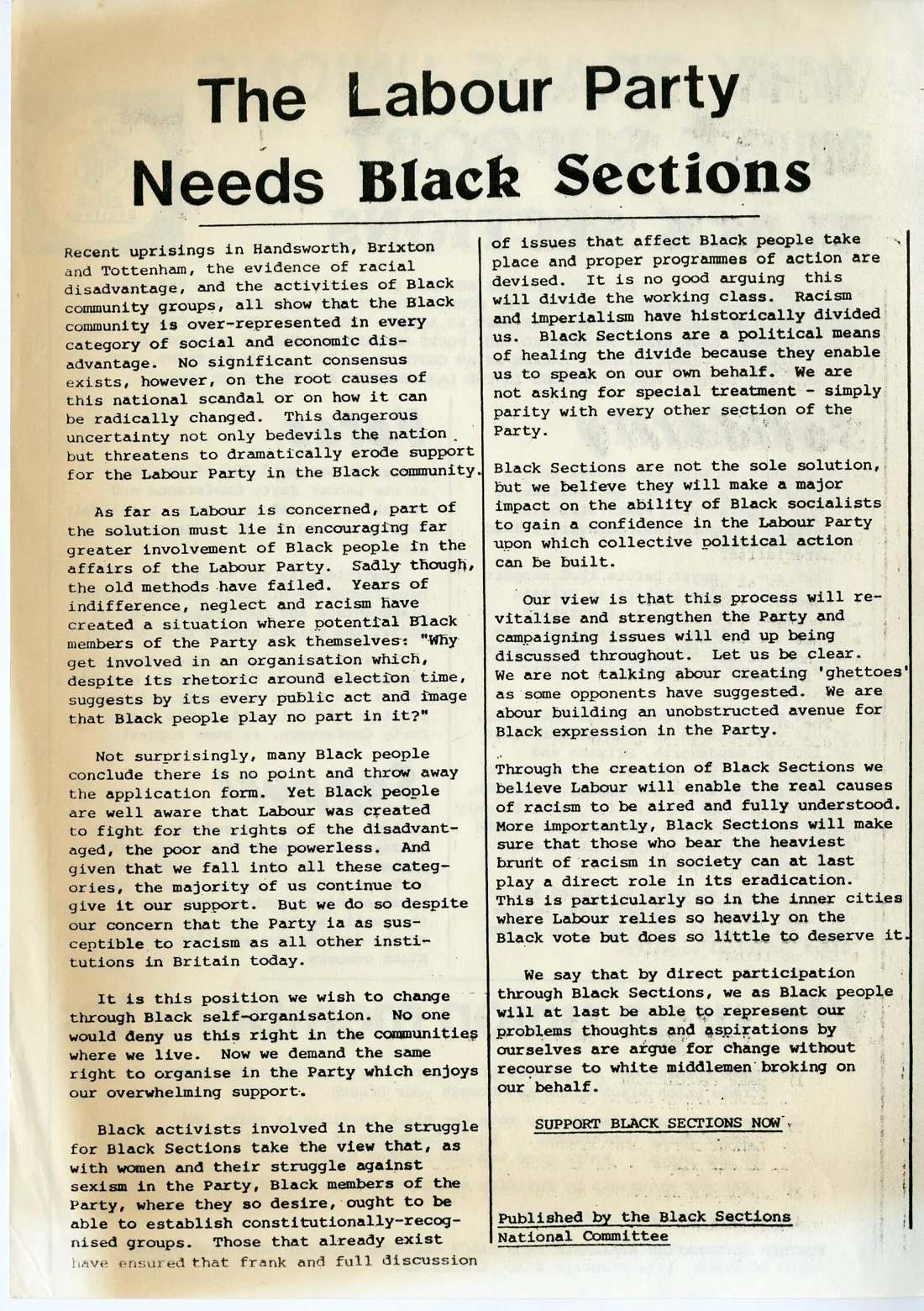
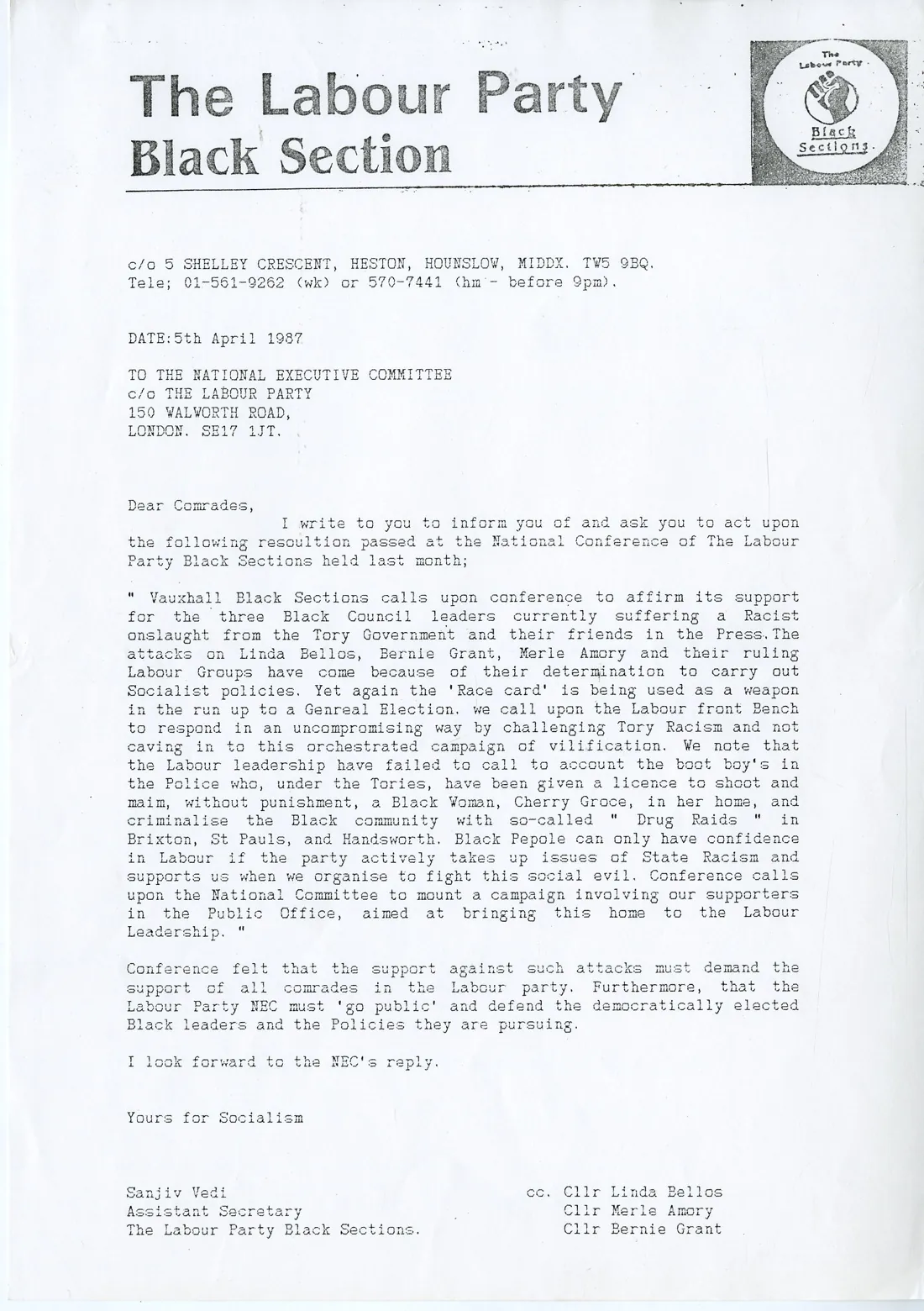
Black Sections also provided a space for Party members to vocalise their demands that the Labour Party protect its own Black members against racism in its various forms. For example, very shortly before Grant’s election as MP for Tottenham, in April 1987, Black Sections passed a resolutionat its National Conference urging the Labour Party to take a stand against the racism experienced by Black Councillors Linda Bellos, Merle Amory, and Grant himself, at the hands of the British Press. These National Conferences and the resolutions produced as a result of them, were a significant part of Black Sections’ advocacy and solidarity work. In 1988, upon Grant’s election to the House of Commons as one of three first Black MPs, Black Sections supported his efforts to press the Labour Party leadership on aspiring to full Black representation at all levels of the party, and asserted this aim at its annual Party Conference. Staying true to its mission as a supportive entity to Black communities in Britain outside of party politics, Black Sections voted to endorse a position paper entitled ‘Positive Action for Cities’, in 1988, a response to Thatcher’s Action for Cities proposal.
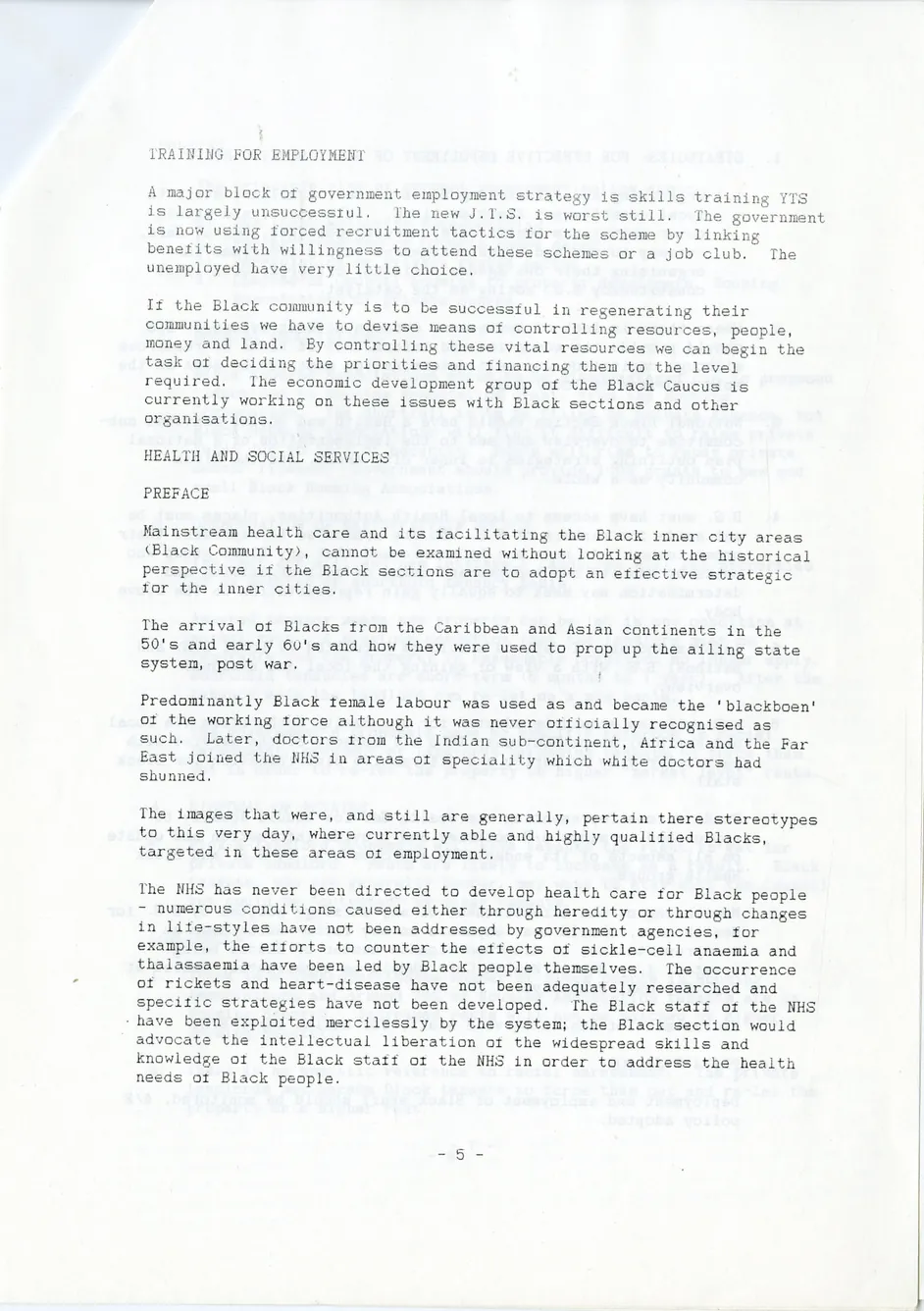
BG_P_11_5_4 Black Section Positive Action for Cities paper
This Labour Party Black Section paper from March 1988 outlines the challenges faced by Black communities in British inner cities, including unemployment, inadequate education, systemic racism, and neglect by government policies. It is useful for understanding Bernie Grant’s campaign as it highlights the socio-economic and political contexts of Black activism and urban regeneration efforts during that period.
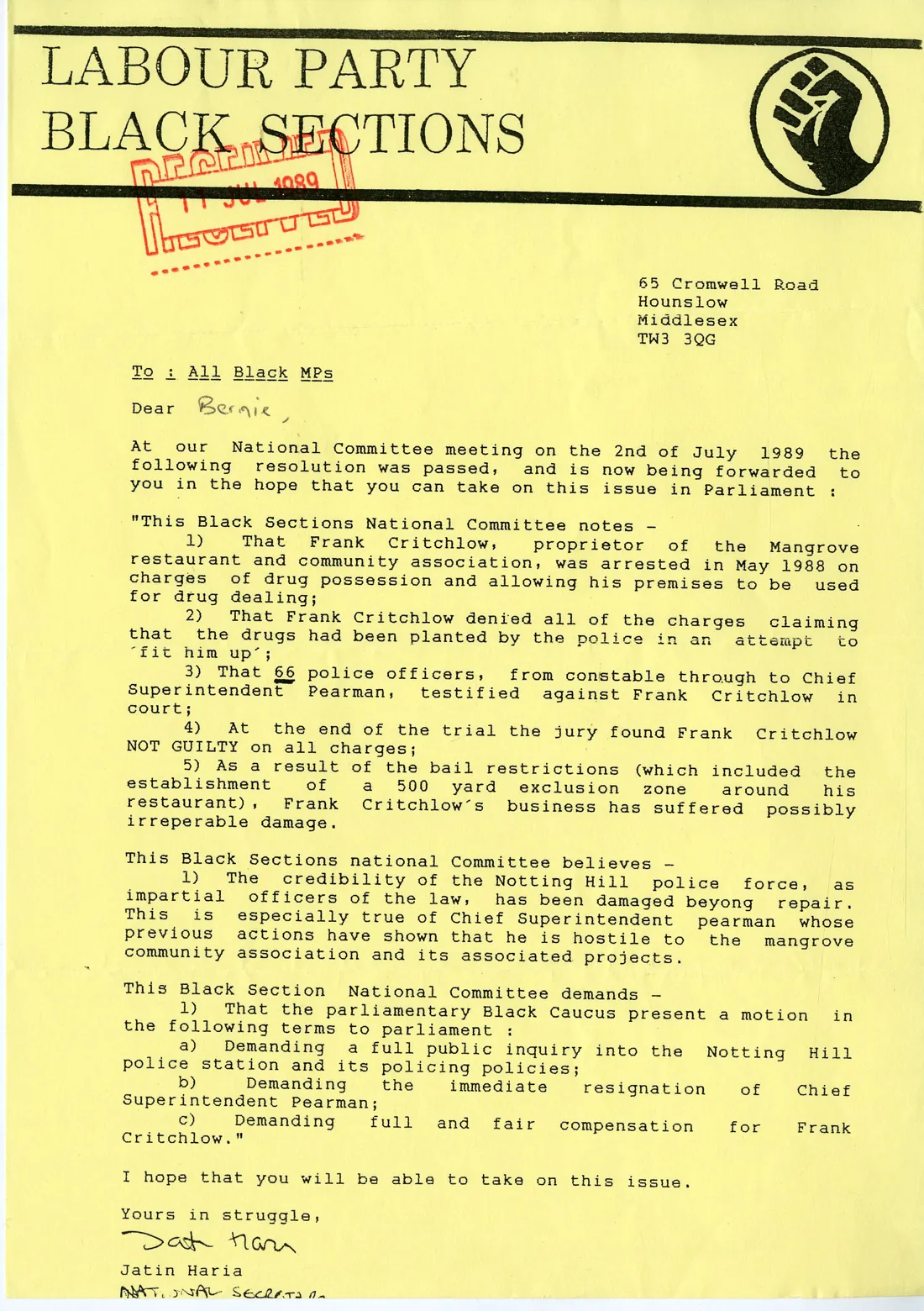
Highlighting the fact that 68% of Black households resided in inner city areas, the position paper condemned the rate capping policy which had negatively impacted inner city councils in particular, and asserted the need for more funding and supportive initiatives to sustain positive development in such communities. The paper noted that the Poll Tax would lead to 92% of London’s inner city Black households losing an annual sum of £759, which is equal to £2,019.70 in 2024. Black Sections passed a resolution in 1989, in support of Frank Critchlow, owner of the Mangrove Restaurant, best remembered for its central role in the Notting Hill Black Power demonstration against police harassment in the 1970, which led to the famous Mangrove Nine trial of 1971. Having been marred by constant police harassment and incessant attempts to criminalise him throughout his career as a restauranter, Critchlow was accused of using his premises for drug dealing. Black Sections demanded a full public inquiry into Notting Hill police station and its policies.
As well as voicing support for victims of racism in Britain, Black Sections often issued resolutions on international issues. A statement from 1986, written by Black Sections candidates standing for roles in the National Executive Committee, affirmed the group’s anti-colonial approach toward the major international issues of the time: “This means stepping up the fight for Black national liberation in Azania (South Africa), support for the demands of the Palestinians and support for British withdrawal from Ireland. Britain must withdraw from NATO”. The statement went into much further detail on its demands for Labour to support the Anti-Apartheid struggle, which the candidates urged was “the most pressing issue” of the time. At the Black Sections ‘87 annual conference, and in the context of the First Intifada (considered to be the first large scale series of uprisings and civil disobedience by Palestinian people against Israeli occupation), Black Sections passed a resolution condemning the Israeli occupation of Palestine, and the Palestinian people. The resolution called on the Labour Party to undertake a number of measures to follow suit, including to recognise the right of the Palestinian people to self determination. Alongside solidarity with the Palestinian struggle, Black Sections took an anti-colonial stance on the Irish struggle for independence and unification, and the South African movement against Apartheid rule.
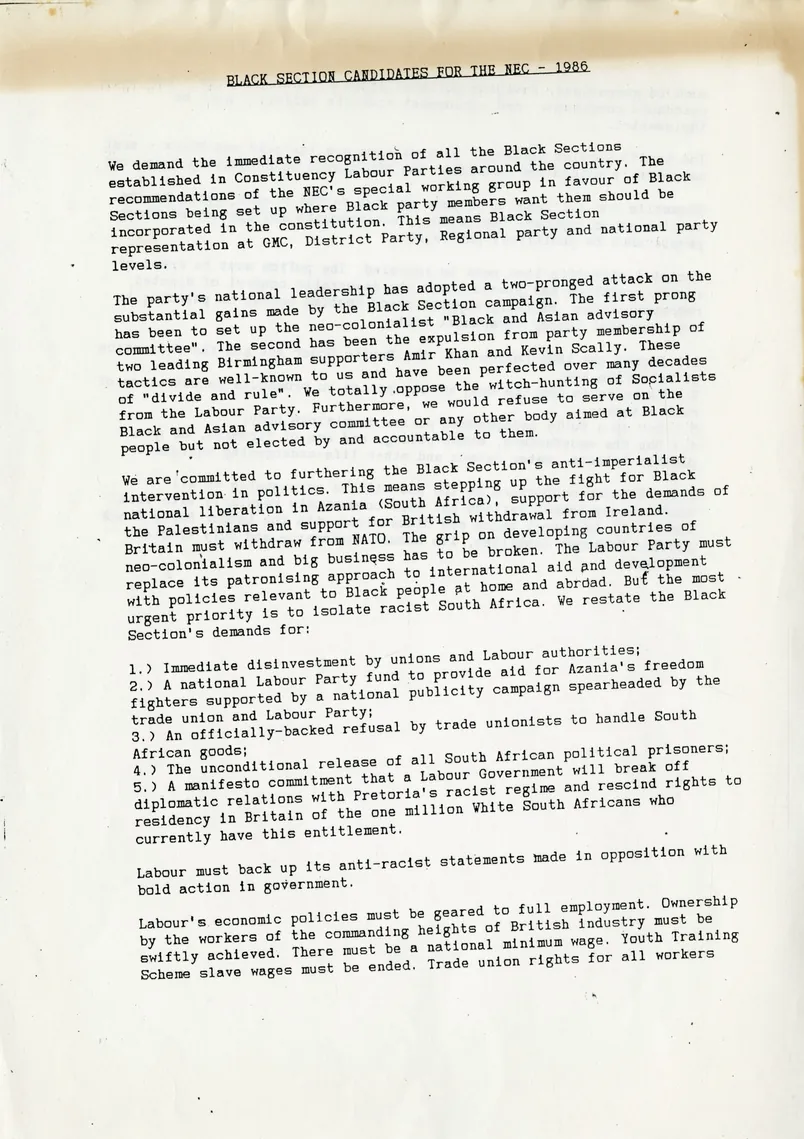
BG_P_11_5_2 Black Section Candidates for NEC
This document outlines the Black Section candidates' platform for the Labour Party's National Executive Committee (NEC) in 1986, emphasizing anti-racist policies, Black representation within the party, and international solidarity against apartheid and imperialism. It is useful for understanding Bernie Grant's campaign and the broader Black Section movement’s goals and challenges, highlighting their commitment to racial equality, accountability, and political activism within and beyond the Labour Party.
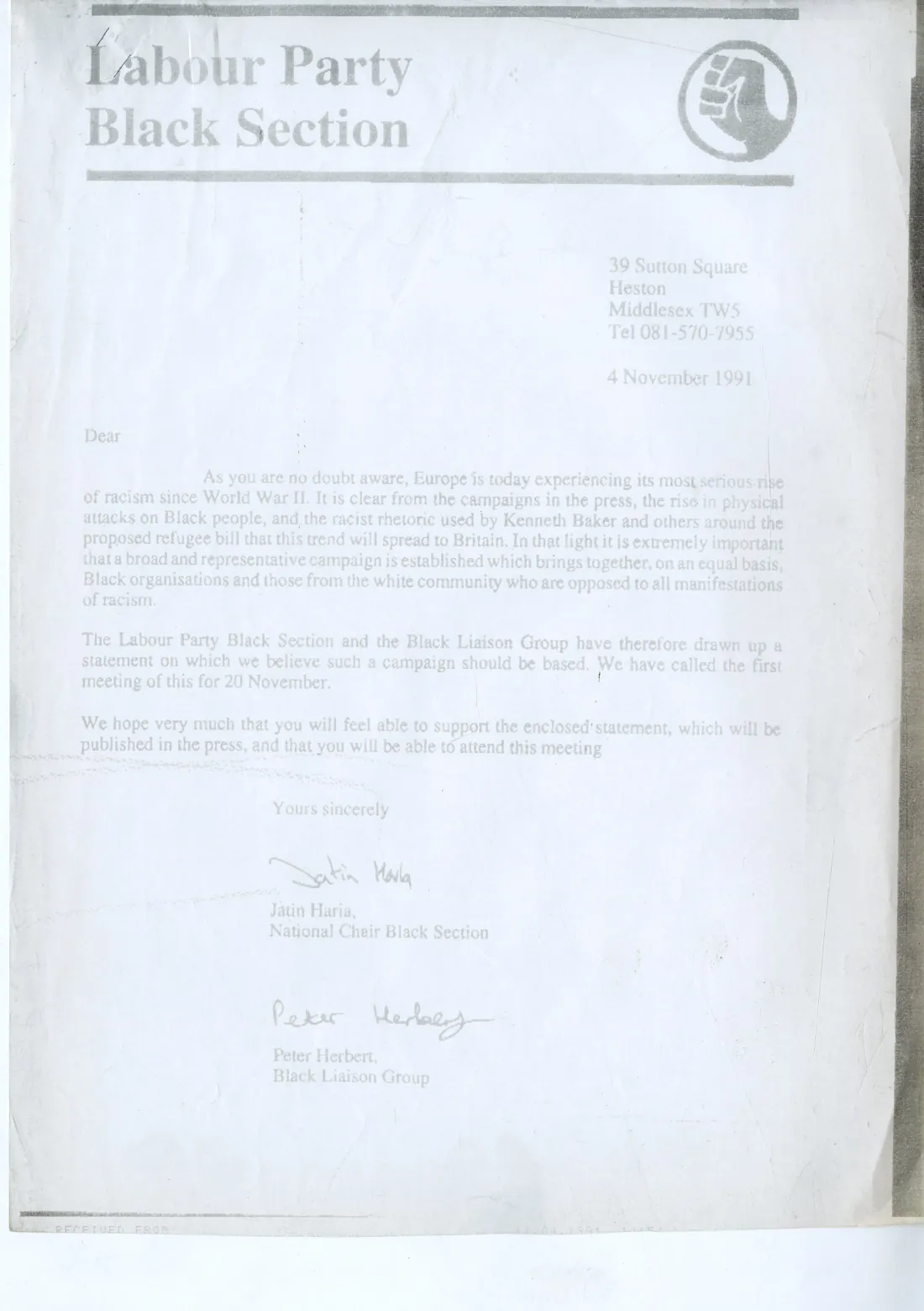
The organisation’s publications, statements, and Annual Conferences all evidence this. In keeping with its global outlook, Black Sections also maintained focus on immigration and citizenship laws, opposing racist actions of the Home Office. In 1991, then-chair of Black Sections Jatin Haria, wrote on behalf of the caucus condemning Europe’s “most serious rise of racism since World War II”. The letter highlighted the racist rhetoric of Home Secretary Kenneth Baker, and the refugee act of 1991 which narrowed the rights of people seeking asylum in the UK. Kenneth Baker was famously found in contempt of court for deporting a man back to Zaire (modern day Democratic Republic of Congo) whilst his appeal was still pending.
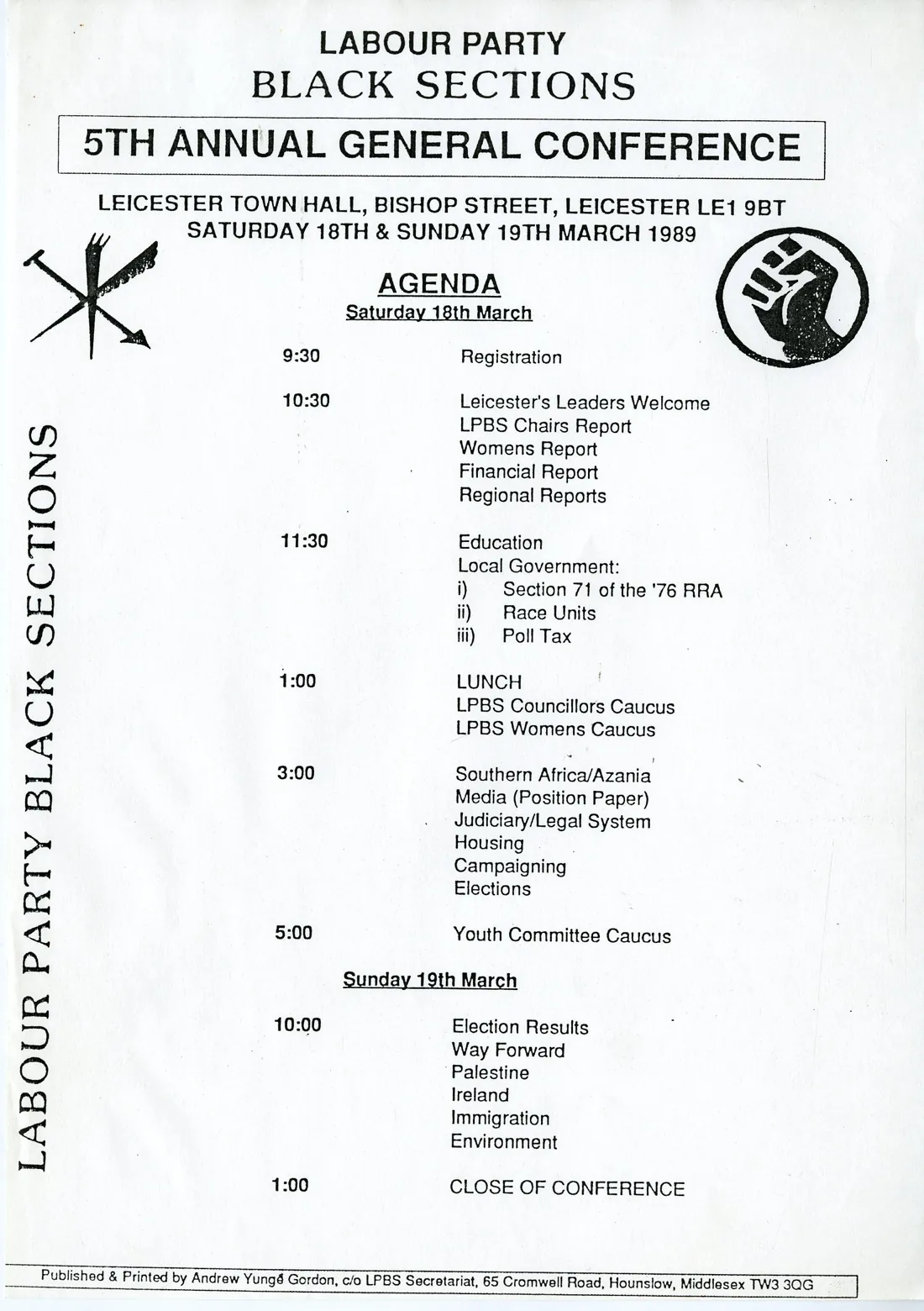
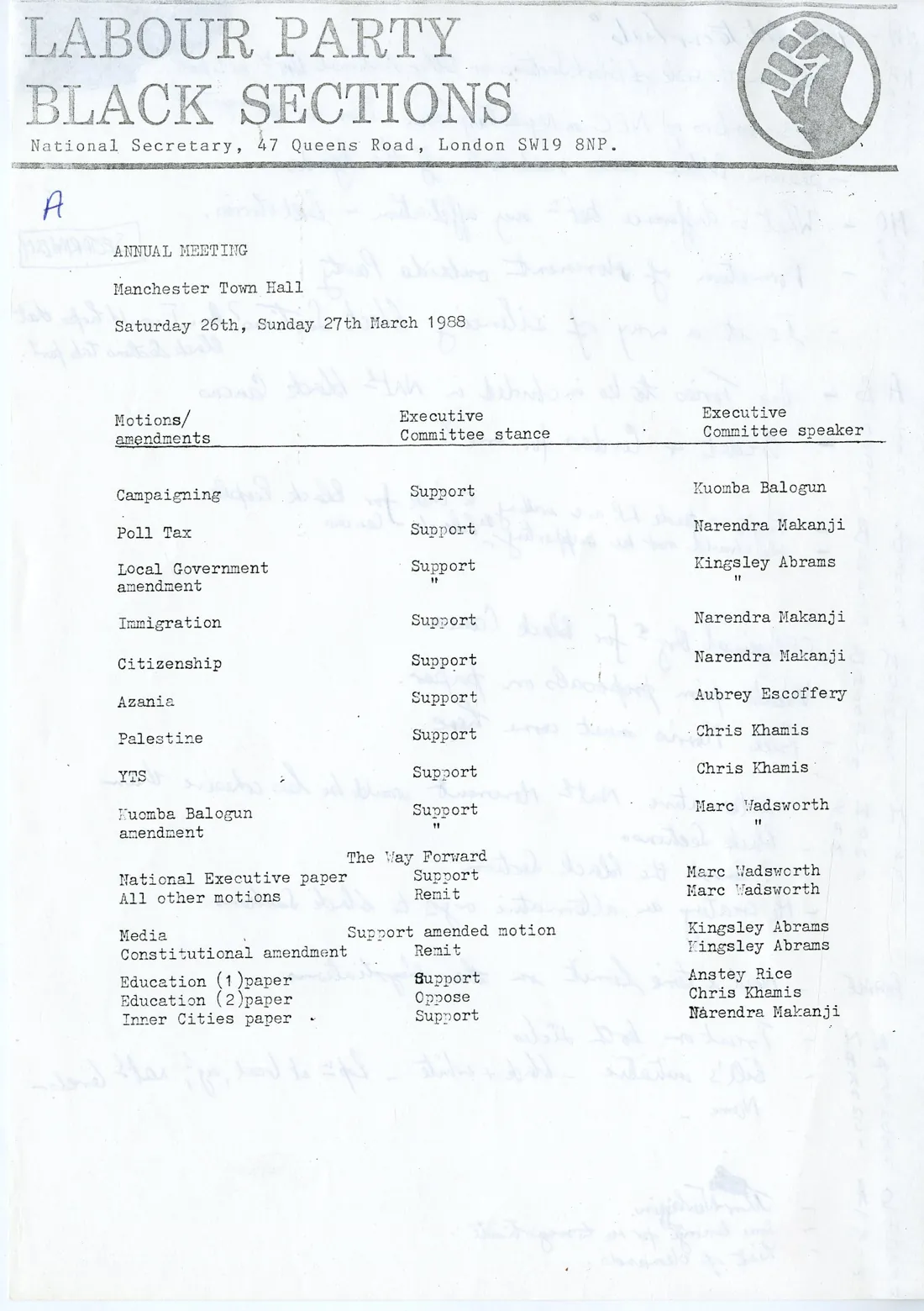
Fuelling Black Sections’ commitment to anti-racism and anti-imperialism was its staunch socialism, and this was also reflected in the caucus’s annual meetings and general activities. Just as Bernie Grant was supportive of the Anti-Poll Tax campaign, and involved with the Socialist Campaign Group which played a leading role in both the Poll Tax rebellion and Miners’ Struggle, Black Sections also supported the Anti-Poll tax campaign and discussed it during their 1988 conference held in Manchester Town Hall. In 1990, the Poll Tax uprising involved 200,000 protestors and was considered one of, if not the most, significant mass uprising since the Peasants’ Revolt of 1381, which was similarly sparked by disdain for an unfair poll tax which disproportionately affected poorer people.
However, the need for Black Sections to exist and conduct its work, was not always recognised by the wider Labour Party leadership, and its National Executive Committee, which steers the strategic direction of the Party. At each Annual Party Conference, Black Sections members argued their case, and were again and again voted against by the majority white Party members. At the 1984 Party conference, Grant, Diane Abbott and Birmingham Ladywood councillor Elaine Foster all addressed the membership on the issues affecting Black people domestically and internationally. Grant, then councillor for the Bruce Grove ward in Tottenham which he noted was 60% Black, referenced the local area’s historical ties to Africa and present day racist immigration policies, commenting: “I mention this because I want to make it clear to comrades that Black people have been in Britain a very, very long time. And we are going to be here a long time”.
Elaine Foster began her speech by offering solidarity to the striking miners both in Britain and South Africa, and demanding answers for the Party’s failures regarding Black political representation, asking “Why has the Labour Party not yet elected the first Black Member of Parliament? Where are the Black Trade Union Leaders?”. Throughout his years as Labour leader, Neil Kinnock, and Deputy leader Roy Hattersley, were, as Marc Wadsworth described “obsessed with defeating a rising Left wing rank”, were vocally disapproving of such an initiative. The Party therefore repeatedly refused to recognise Black Sections as an official Labour affiliate. This was despite the fact that other caucasus designed to represent marginalised groups or specific sections of the Labour movement, were supported, such as the Women’s Committee and Young Socialists.
